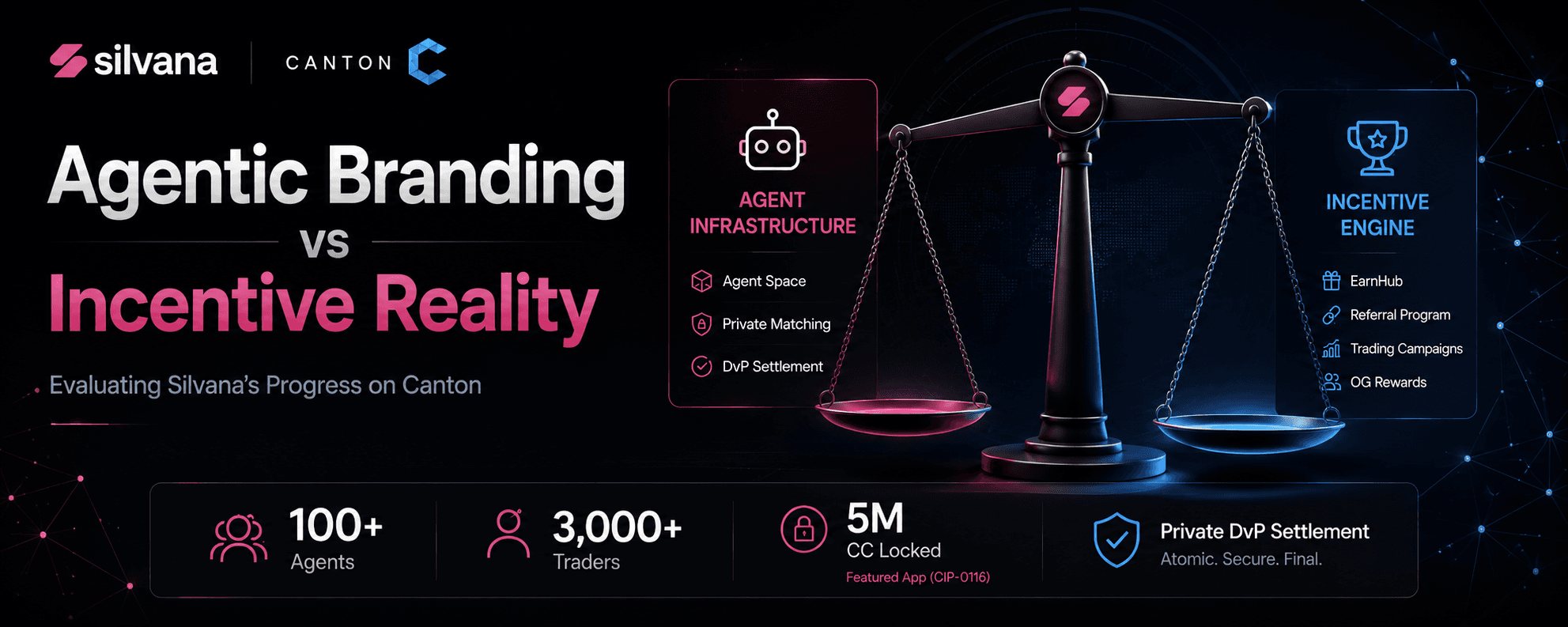

Agentic Branding vs. Incentive Reality: Evaluating Silvana's Progress on Canton
Silvana has emerged as one of the strongest proponents of the agentic vision within the Canton ecosystem. Its message has remained remarkably consistent: autonomous agents capable of trading, settling, and proving transactions, supported by more than 100 deployed agents, over 3,000 onboarded traders, private off-chain order matching, atomic Delivery-versus-Payment (DvP) settlement on Canton, and an expanding Agent Space equipped with templates and an SDK.
These claims have been repeated across Silvana's official communications and CantonNews throughout 2026. From a technical perspective, the vision is compelling. The more meaningful question, however, is whether the publicly observable activity today reflects that long-term vision.
The Activity We Can Actually Observe
Reviewing Silvana's public updates between mid-June and early August 2026 reveals a clear pattern.
Most announcements focused on EarnHub seasons, which quickly progressed from Season 7 through Season 11, alongside Trading Pair of the Month campaigns, referral incentives, Discord OG programs, and various community reward initiatives.
By comparison, updates demonstrating autonomous agent performance, independent agent behavior, or measurable agent-driven trading activity have been relatively limited.
This should not be interpreted as evidence that the agents do not exist. Rather, it highlights a disconnect between Silvana's agent-centric branding and the content most users encounter through its public channels.
Privacy Makes Independent Verification Difficult
Part of this disconnect stems directly from Silvana's architecture.
Orders are matched privately off-chain before being settled atomically on Canton using Delivery-versus-Payment (DvP). This design protects institutional participants and autonomous agents by preventing strategy exposure and minimizing information leakage that would otherwise occur in public order books.
The same privacy that strengthens execution also limits transparency.
Because matching occurs off-chain and order books remain private, independent observers have no practical way to determine how much trading activity originates from autonomous agents versus users participating in incentive campaigns such as EarnHub.
Silvana has publicly referenced figures exceeding 100 deployed agents and more than 3,000 traders. However, the methodology behind those numbers has not been publicly explained, making external verification difficult.
Privacy, therefore, functions as both a competitive advantage and an analytical limitation.
Incentives Are Normal, Positioning Changes Expectations
Silvana is far from the only application on Canton relying on seasonal incentives to accelerate adoption. Across emerging blockchain ecosystems, liquidity mining and reward campaigns are standard mechanisms for attracting early users.
The distinction lies in positioning.
Projects that market themselves primarily as exchanges or yield platforms are naturally expected to depend on incentive programs. Silvana, however, has built its identity around autonomous agents.
That creates a different expectation: over time, autonomous agents should become the primary source of platform activity rather than existing alongside continuous incentive campaigns.
Silvana has also demonstrated long-term commitment by securing Featured App status through locking 5 million $CC under CIP-0116. While this reinforces confidence in the project's commitment to Canton, it does not directly answer how much of today's activity is genuinely agent-driven.
The Key Trade-Off
Silvana illustrates a familiar trade-off in modern financial infrastructure.
Greater privacy enables more sophisticated execution while protecting sensitive strategies from unnecessary exposure.
At the same time, it reduces the amount of publicly available information that would allow the broader ecosystem to independently evaluate adoption.
Similarly, reward campaigns are highly effective at bootstrapping liquidity and user growth. The more important milestone will be the point at which organic, product-driven activity begins replacing incentive-driven participation.
Questions Worth Monitoring
Several questions remain unanswered:
- What percentage of settled trading volume originates from autonomous agents rather than incentive participants?
- How many of the reported 100+ agents operate with minimal or no ongoing human intervention?
- Will EarnHub campaigns become less frequent as agent adoption matures over the coming months?
Future updates that could provide stronger evidence include:
- More detailed reporting on Agent Space development and real-world agent performance.
- High-level disclosures distinguishing autonomous agent activity from human trading.
- A gradual reduction in reliance on seasonal incentive programs.
- Continued Featured App participation and reward distributions as indirect indicators of sustained ecosystem engagement.
Conclusion
Silvana has built a credible technical foundation and reinforced its long-term commitment through Featured App status and its 5 million $CC lock on Canton.
At the same time, the publicly visible ecosystem remains largely shaped by incentive programs, while evidence of autonomous agent activity is inherently difficult to verify due to the platform's privacy-first design.
Ultimately, the next phase matters more than today's narrative.
If autonomous agents become increasingly responsible for platform activity while dependence on incentives gradually declines, Silvana's positioning will become significantly stronger.
For now, it represents an interesting stage in Canton's evolution: advanced private agent infrastructure supported by an ecosystem that is still heavily leveraging incentives to build momentum.