
Zenith connects its EVM testnet to 15 external test networks in Cosmos pilot. Graphic by CantonNews.
Developers on the Zenith EVM testnet can now send a test token to Ethereum Sepolia. Zenith says the Cosmos-built pilot connects its environment to 15 external test networks, including Sepolia, Tempo, Arc and Besu environments.
Sepolia is an Ethereum network used to try out software before deploying it with real assets. The result Zenith describes is specific: a developer can send a test token from Zenith to Sepolia. The announcement names the other connected environments without reporting an equivalent transfer on each one.
How a transfer leaves Zenith
Zenith gives developers a place to run applications written for the Ethereum Virtual Machine, the software environment used by Ethereum contracts. When Zenith opened its testnet, its Gateway was the link between that environment and Canton applications.
The Cosmos pilot addresses a different part of the journey. It uses Inter-Blockchain Communication, or IBC, to explore connections between Zenith and external networks. A developer starting with an asset on Zenith can test that external leg directly. An application that also needs to move an asset between Canton and Zenith would use the Gateway for that part.
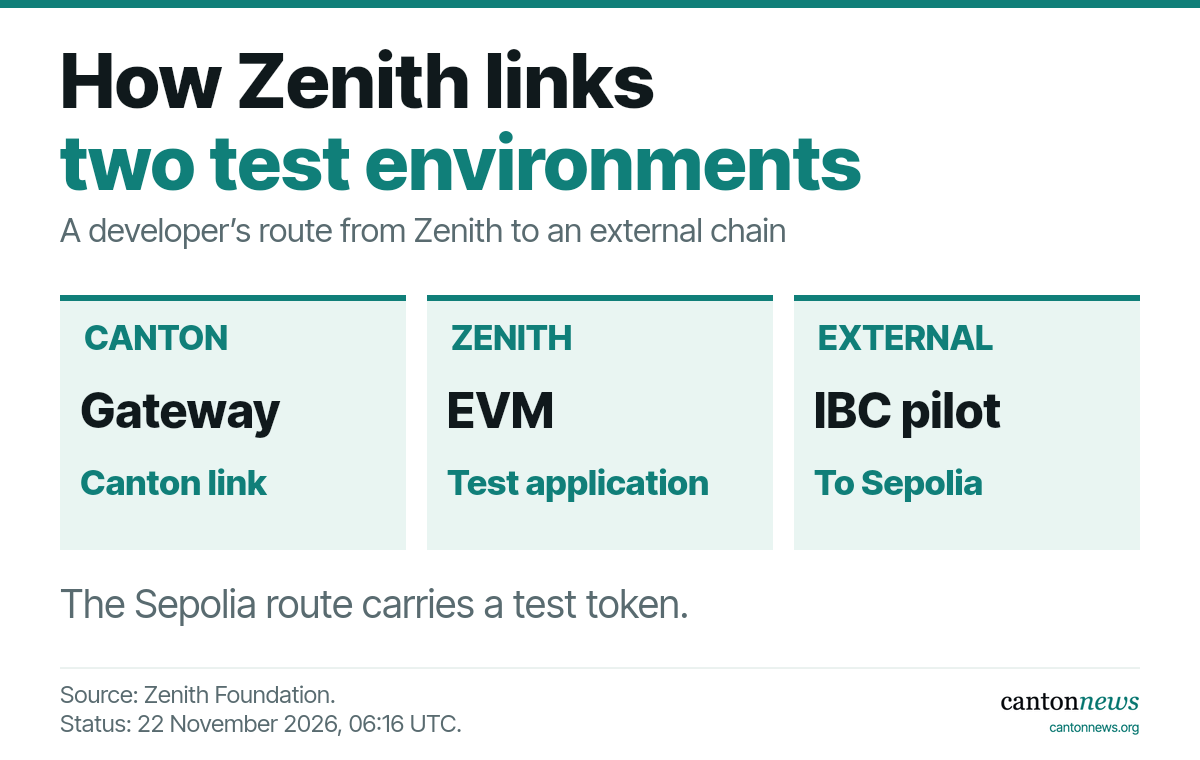
The two connections described by Zenith. Zenith pilot announcement.
For a team building a Canton application, this gives it two questions it can test separately: whether its asset can move into the EVM environment, and how an external application handles it once it leaves Zenith. Zenith’s November 20 update documents the test-token route to Sepolia. Mainnet availability and production limits remain open questions.
Project profile: Zenith.
Sources: Zenith’s pilot update and its EVM testnet introduction.