
Canton’s data infrastructure has been developing beyond basic network activity and transaction visibility. Indexing services, analytics platforms, market data providers, oracle integrations and emerging financial benchmarks are creating new ways to observe activity across the ecosystem.
But better access to data does not automatically translate into better financial decisions.
For financial institutions, the value of data is measured by whether it can support decisions about who to lend to, what collateral to accept, how much to lend against it, when to request additional collateral and whether an asset can be liquidated without creating unacceptable losses.
These decisions require more than a token price or a record of on-chain activity. They require reliable information about asset ownership, market depth, borrowing costs, collateral exposure, custody arrangements and the conditions under which assets can be sold.
This raises an important question: can Canton’s developing data infrastructure provide the information needed to support institutional financial decisions?
Financial decisions require more than asset prices
Consider a financial institution considering a loan secured by CC.
The first question is not simply how much the collateral is worth. The institution must establish whether the borrower is eligible, whether the collateral can legally be accepted, how reliably it can be valued and whether it can be sold if the borrower fails to meet their obligations.
A quoted market price provides only one part of that assessment.
A collateral asset may have a quoted value of $1 million, but that does not mean a lender can recover $1 million by selling it. The actual recovery depends on available buyers, order-book depth, trading volume, price impact, execution costs and the time required to complete the sale.
This distinction separates market value from liquidation value.
Market value provides a reference for what an asset is worth under prevailing market conditions. Liquidation value estimates what can realistically be recovered when an asset must be sold within a defined period and under specific market constraints.
For a lender, the second figure can be more important when determining how much credit to extend.
The same principle applies to borrower assessment. Collateral does not replace an evaluation of repayment capacity. A lender may have sufficient collateral coverage but still face operational, legal or market risks that affect recovery.
Financial institutions therefore need a connected view of the borrower, the asset, the market and the legal arrangements surrounding the transaction.
The data infrastructure behind financial decisions
The information required for lending and collateral management comes from several distinct sources. No single provider or data feed is likely to supply everything an institution needs.
Network data and indexing provide visibility into activity on the network.
Canton's APIs and indexing services help applications access relevant ledger information, including transactions, parties, transfers and application activity. The available information depends on the access rights and privacy arrangements governing the underlying data.
This is important because Canton is not a fully public ledger where every participant can inspect every transaction. A financial application may have access to information that is not visible through a public-facing data service.
Providers such as Noves, CC View, Coin Metrics and CCTools contribute to this layer through different approaches to indexing, analytics and network data access.
However, network activity is not equivalent to a complete financial picture. Transaction records can show that an asset moved, but they do not necessarily establish its legal ownership, whether it is encumbered or whether it can be liquidated at a particular price.
Market data and price discovery form another layer.
Market data providers help applications observe prices, trading activity, order books, market depth and other indicators of market conditions.
CantonCap contributes market and liquidity information across supported markets. External data providers and oracle infrastructure can also help bring market information into applications.
Chainlink's partnership with Canton introduced a path for its data and interoperability services to support the ecosystem. Kaiko and New Change FX have also announced work involving regulated foreign exchange benchmarks.
These developments matter because a lending application needs more than a displayed token price. It needs to understand where that price comes from, how frequently it changes, how much liquidity supports it and whether the information is suitable for the decision being made.
A price feed can provide a reference value. It cannot, by itself, guarantee that a lender can sell a large position at that value.
The third layer is credit and specialist financial information.
Financial institutions need information about borrowing costs, collateral coverage, liquidity under stress, credit exposure and the financial condition of counterparties.
This is where emerging initiatives such as KC&C become relevant.
KC&C is developing benchmarks intended to describe aspects of Canton Coin's borrowing costs, liquidity and reward-related coverage. Its work represents an attempt to move beyond basic network analytics towards information that could contribute to financial risk assessment.
That is a meaningful direction, but the distinction matters: an emerging benchmark is not automatically an institutionally validated credit rating, and a market indicator is not a complete underwriting model.
What existing Canton applications demonstrate
The most useful way to evaluate this infrastructure is to look at applications already attempting to support financial activity.
Alpend provides an example of how collateral and debt information can be used within a lending application.
Its lending model considers collateral balances, oracle prices, outstanding debt and asset-specific lending parameters. These inputs help determine how much a user can borrow and when a position becomes eligible for liquidation.
Two important concepts are maximum loan-to-value and health factor.
Maximum loan-to-value determines how much a borrower can borrow relative to the value of eligible collateral. The health factor provides an indication of how close a position is to its liquidation threshold.
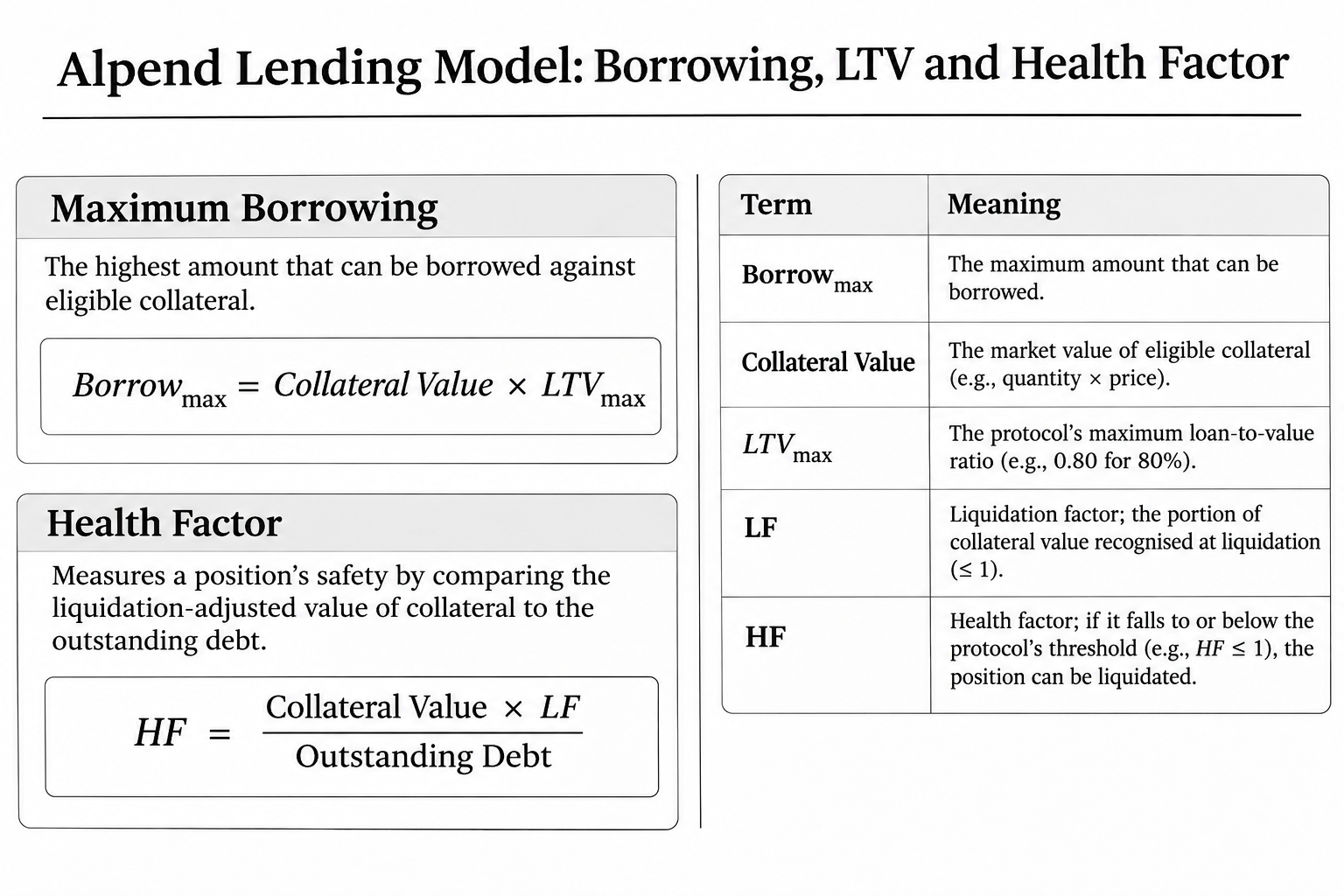
The graphic should show the maximum LTV and health-factor calculations, with brief explanations of each variable.
In simplified terms, the health factor compares the liquidation-adjusted value of collateral against outstanding debt. When the value falls below the protocol's required threshold, the position becomes eligible for liquidation under the application's rules.
Alpend demonstrates that Canton-based applications can use market prices and on-ledger financial positions to manage collateralised borrowing.
Its security review and testing are also relevant evidence of implementation work. However, software security testing does not establish that the underlying price feeds are economically representative or that sufficient liquidity will always exist during a market shock.
The remaining question is how reliably the system can recover value when liquidation is required under difficult market conditions.
Haven Digital Partners provides a different example.
Its Canton lending marketplace is designed for permissioned institutional participants rather than an entirely open lending environment. The model includes participant verification, negotiated loan terms, collateral arrangements and custody infrastructure.
This reflects a different set of requirements from a public lending pool.
Institutional lending involves more than recording a loan and tracking collateral. Participants need to establish who is authorised to transact, where collateral is held, what legal agreements govern the transaction and how collateral can be managed if market conditions change.
Haven's model incorporates off-chain legal agreements alongside on-chain records and settlement processes. Its use of BitGo custody infrastructure is also relevant to the operational side of collateral management.
This illustrates an important point: institutional financial infrastructure must connect network-level information with legal, custody and operational arrangements.
However, public information does not provide a complete view of Haven's underwriting methodology or loan-performance history. It would therefore be premature to treat the platform as proof that every institutional credit-data requirement has already been solved on Canton.
KC&C is particularly relevant to the question of whether Canton's data ecosystem can evolve from tracking activity towards supporting financial decisions.
Its published methodology includes several indicators.
Liquidation Capacity estimates how much CC can be sold across selected venues under defined price-impact conditions.
Dollar Rate tracks the cost of borrowing USDCx relative to CC through selected lending markets.
CC Borrow Rate tracks selected external exchange and on-ledger borrowing rates.
Reward Coverage uses historical rewards and borrowing assumptions to estimate a form of reward-based coverage.
CC Burn/Mint Ratio provides context on network-related CC burning and inferred issuance.
These indicators address different aspects of financial activity.
Liquidation Capacity is relevant to collateral risk because it attempts to estimate how much of an asset can be sold without exceeding a defined price-impact threshold. Borrowing-rate indicators can help describe the cost of financing. Reward Coverage offers a limited way to examine whether historical rewards could cover a hypothetical borrowing obligation.
But these indicators should not be treated as interchangeable with a full credit assessment.
For example, Reward Coverage does not establish the complete financial condition of a borrower, while Liquidation Capacity does not prove that a particular lender can access all the liquidity included in the estimate.
KC&C's methodology is also an emerging, founder-operated initiative. Its published methodology and version history provide transparency, but independent oversight and validation remain important areas for development.
The significance of KC&C is therefore not that it has already solved institutional credit assessment. It is that it is beginning to build a financial information layer around assets and activity within the Canton ecosystem.
Why market value is not liquidation value
The difference between a quoted price and recoverable value becomes clearer when applied to a numerical example.
Assume a lender accepts 10 million CC as collateral.
At a reference price of $0.073 per CC, the collateral has a quoted market value of $730,000.
That figure is useful, but it does not tell the lender how much money can be recovered through a sale.
To estimate execution value, the lender must examine available bids and calculate how much the market can absorb at different prices.
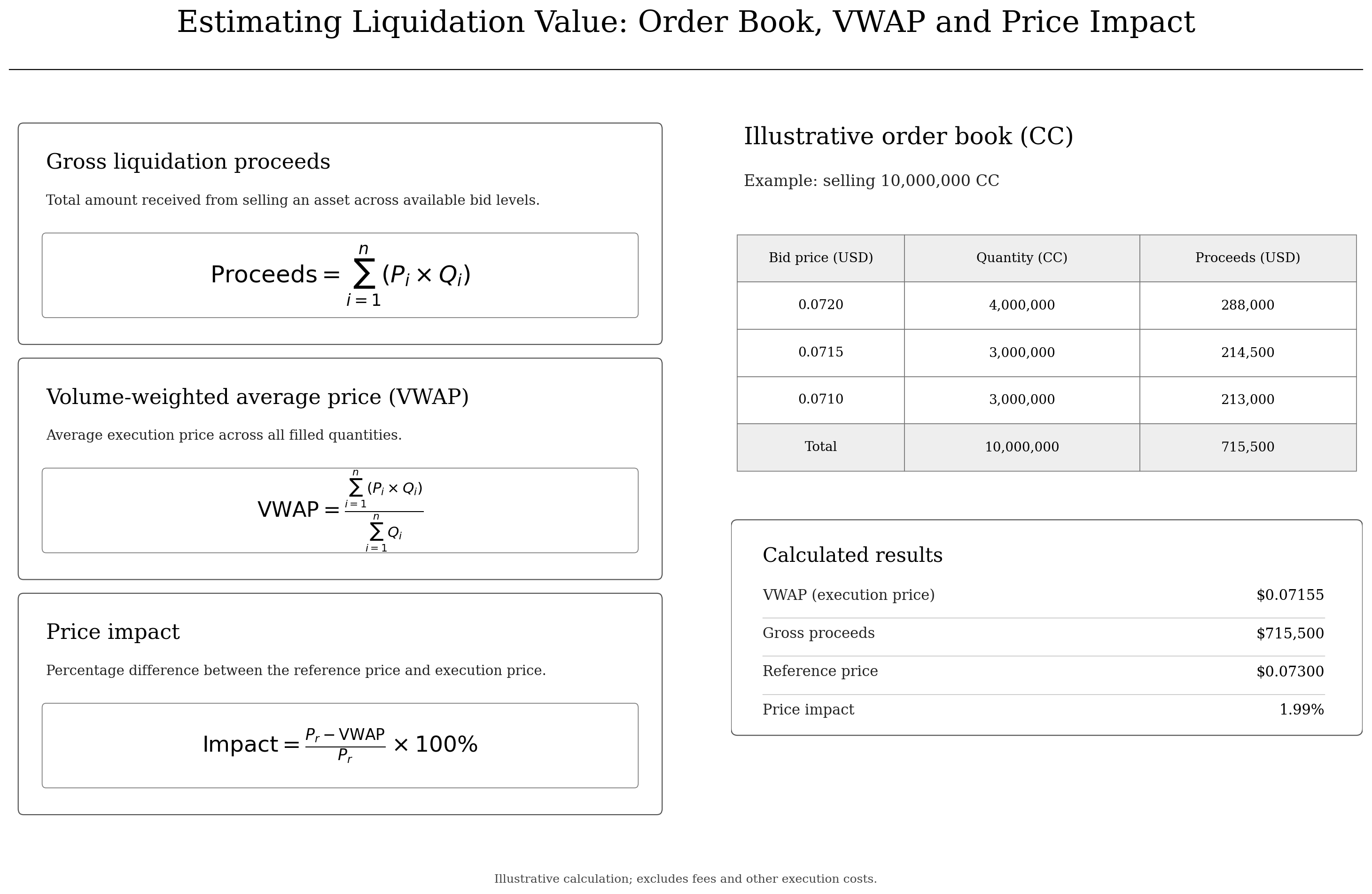
The graphic should explain gross liquidation proceeds, volume-weighted average execution price (VWAP) and price impact. Use a simple order-book example rather than a wall of equations.
Using the KC&C snapshot and its reported 2% average price-impact estimate, the illustrative average execution price would be approximately $0.07154 per CC.
Selling 10 million CC at that price would produce approximately $715,400 in gross proceeds, before fees and other execution costs.
The difference between the quoted value and this estimated execution value is $14,600.
This is a boundary calculation based on the published market-capacity estimate. It is not evidence that an actual 10 million CC liquidation took place at that price.
The distinction is important because a lender's recovery depends on the liquidity available when the sale happens, not simply on the asset's displayed market price.
Assume the lender applies an 80% loan-to-value ratio.
Against $730,000 in quoted collateral value, the loan would be $584,000.
Under the illustrative execution estimate of $715,400, the lender would have a gross recovery buffer of $131,400 before fees and other costs.
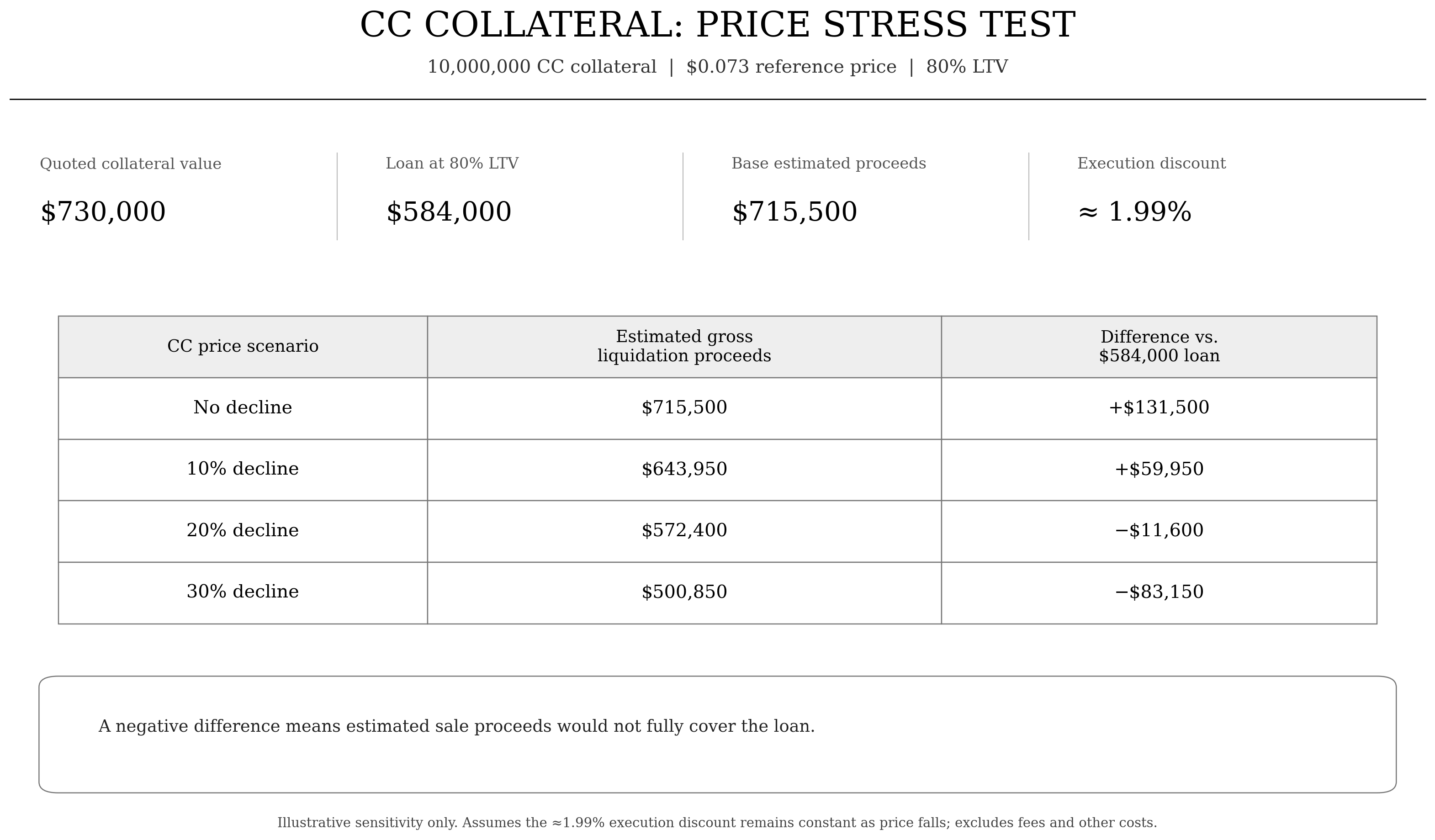
The graphic should show the four scenarios: no price decline, 10% decline, 20% decline and 30% decline. Include estimated gross proceeds and the difference against the $584,000 loan.
That buffer is not guaranteed protection. It depends on the reference price, available liquidity and execution assumptions remaining sufficiently accurate.
If the market price declines while liquidity remains unchanged, the recovery buffer becomes smaller. If liquidity also deteriorates, the lender may face a much more difficult recovery process.
The figures in the stress test hold the assumed execution discount constant. They are sensitivity illustrations, not a full market simulation. In a real stress event, the order book itself could deteriorate, making the actual execution price worse.
KC&C's reported snapshot estimated approximately 52 million CC of liquidation capacity under its defined 2% average price-impact measure.
A 10 million CC position represents approximately 19.2% of that estimated capacity.
At first glance, that appears to provide a meaningful margin. But aggregate market capacity is not the same as liquidity that a specific lender can immediately access.
The estimate covers selected venues. A lender's actual ability to use that liquidity depends on venue access, custody arrangements, transfer restrictions, settlement processes and the availability of executable bids when the sale occurs.
If reported capacity falls by 50%, the estimated capacity becomes 26 million CC. A 10 million CC position would still fit within that estimate.
If capacity falls by 80%, it becomes approximately 10.4 million CC. The position would then sit close to the entire estimated capacity.
A reduction of slightly more than 80% would mean the 10 million CC position no longer fits within the original 2% price-impact threshold.
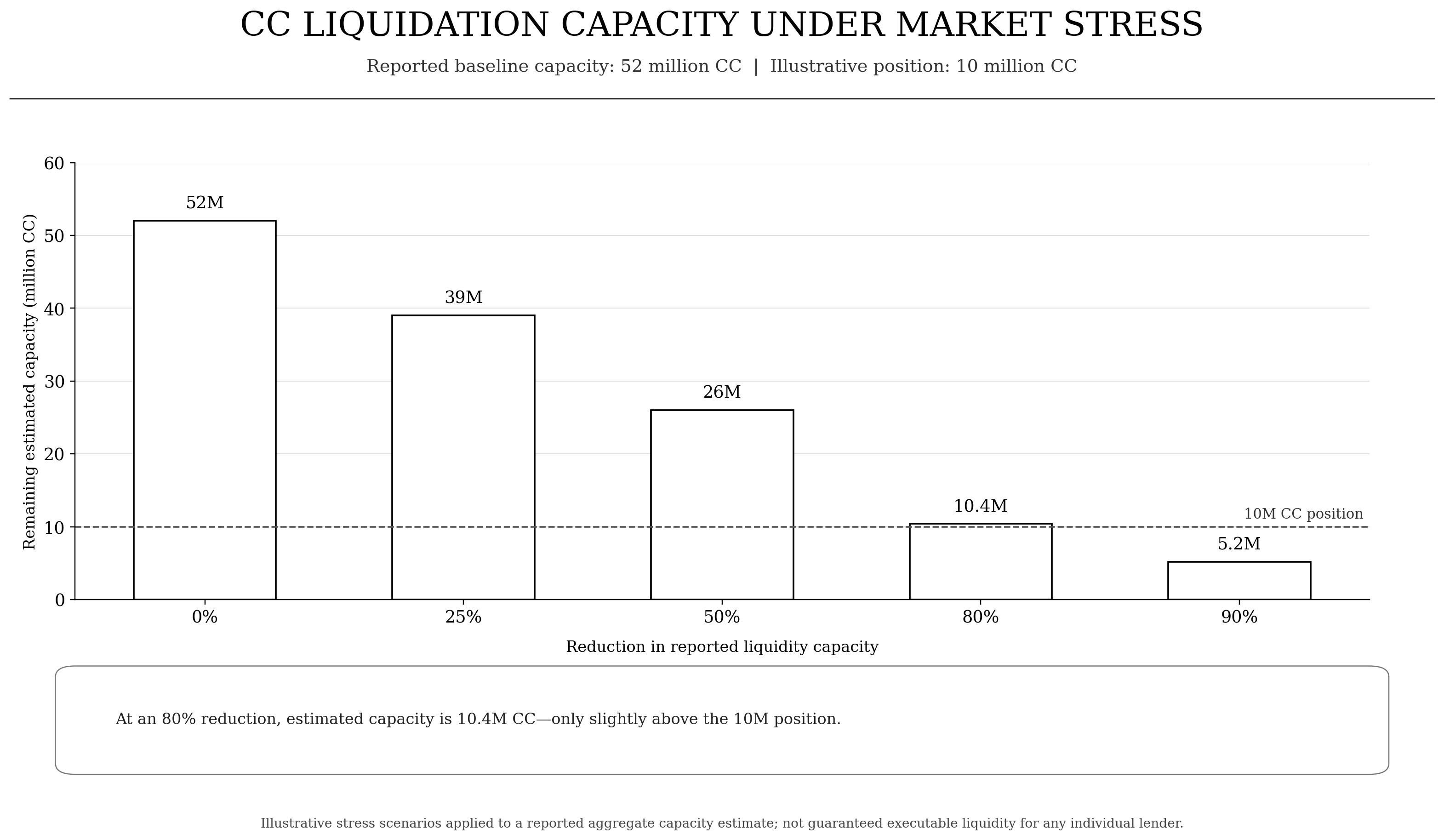
The graphic should compare the original 52 million CC capacity against 25%, 50%, 80% and 90% reductions, highlighting the point where a 10 million CC position no longer fits within the estimated capacity.
This illustrates why liquidity monitoring must be continuous. A collateral position that appears adequately covered in normal conditions may become difficult to recover during market stress.
What Canton still needs to strengthen
The existing infrastructure demonstrates meaningful progress, but several gaps remain before it can reliably support a broader range of institutional financial decisions.
Liquidity estimates are only as useful as the markets and venues included in their calculations.
A benchmark based on selected order books may not represent all available liquidity. It also does not automatically account for liquidity that is inaccessible to a particular lender.
Providers need to make venue selection, data coverage, exclusions and calculation assumptions transparent.
Standardisation is another challenge.
Network analytics, market data, lending information and collateral records are often collected and presented differently.
Institutions need consistent definitions for asset identifiers, timestamps, prices, volumes, borrowing rates, collateral balances and data freshness.
Without common definitions, combining information from multiple providers becomes more difficult and can introduce errors into risk calculations.
Independent benchmark validation is equally important.
Publishing a methodology is important, but methodology transparency is only one part of benchmark credibility.
Financial institutions need confidence that the calculations are accurate, the underlying data is sufficiently representative and the results can be independently reproduced.
For KC&C, independent review of its data collection, calculation process, governance and conflict-management arrangements would strengthen confidence in its benchmarks.
The same principle applies more broadly to any provider whose data could influence lending or collateral decisions.
Public market data cannot establish every fact an institutional lender needs to know about collateral.
Ownership, custody, liens, transfer restrictions and enforceability may require permissioned information and supporting legal documentation.
Canton's privacy model makes this particularly relevant. The objective should not be to make every financial record public. It should be to enable authorised participants to access the information required for a specific decision.
Historical data and stress testing also need attention.
A short period of observed market activity cannot fully represent the conditions institutions may face during a prolonged market downturn.
Financial applications need longer historical datasets and stress scenarios that combine price declines, falling liquidity, higher borrowing costs, delayed settlement and changing collateral requirements.
Testing each variable independently is useful, but institutional risk management also needs to understand how several adverse conditions interact.
Perhaps the most important gap is the connection between financial data and actual outcomes.
A provider may publish a liquidity estimate. A lending application may use a price feed. A benchmark may calculate borrowing costs.
But the critical questions remain: did the information influence a lending or collateral decision? Did the resulting risk parameter perform as expected? How much was recovered during liquidation? How did actual execution compare with the estimated liquidation value? Were borrowers able to meet their obligations?
There is currently no public evidence establishing that Alpend or Haven uses KC&C's benchmarks as inputs to its lending decisions.
KC&C's published use of Alpend's lending-rate information demonstrates a connection in the other direction: an application-level data source can contribute to a wider financial benchmark.
That is a useful starting point, but it is not yet evidence of an integrated institutional risk system.
The architecture Canton could develop
The opportunity is to connect the existing pieces into a more complete financial information architecture.
At the foundation are the data sources: network records, application activity, market prices, order books, custody information and borrower data.
Above that sits a permissioned access and standardisation layer. It determines which participants can access specific information and ensures that data from different sources can be compared consistently.
The next layer is financial intelligence. This is where information is transformed into usable indicators such as collateral valuations, borrowing rates, liquidity estimates, risk parameters and stress scenarios.
Financial applications can then use those indicators to support lending, collateral management, repo transactions, margin requirements and settlement.
The final layer is outcome validation. It compares estimates with what actually happened: repayments, liquidation proceeds, execution costs, recovery rates and model performance.
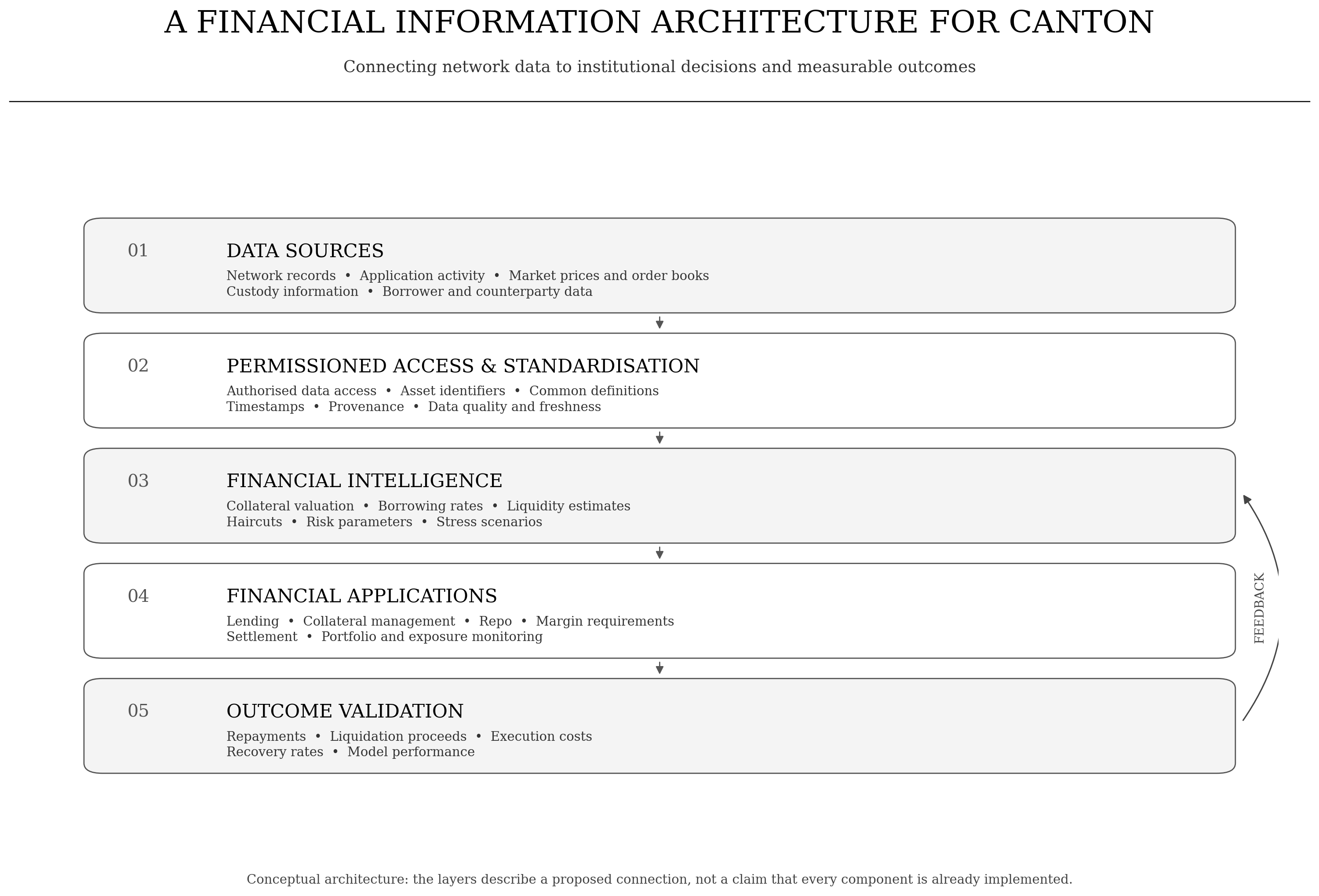
The graphic should show the five connected layers: data sources; permissioned access and standardisation; financial intelligence; financial applications; and outcome validation. Include a feedback loop from outcome validation back to the earlier layers.
The final layer is particularly important. Without it, a benchmark can remain a calculation that looks reasonable on paper but has not been tested against real financial outcomes.
A reliable system should learn from the difference between estimated and realised results.
Canton's data infrastructure is developing in a direction that could support more sophisticated financial applications.
Network indexing and analytics provide visibility into activity. Market data and oracle infrastructure can help applications access pricing information. Lending applications such as Alpend demonstrate how collateral and debt data can support on-chain risk controls. Haven illustrates the importance of permissioned institutional lending, custody and legal arrangements. KC&C is exploring how market and lending information can be organised into financial benchmarks.
These are meaningful building blocks.
But the ability to publish data is not the same as the ability to support institutional financial decisions.
That requires representative market coverage, reliable data provenance, permissioned access, standardised definitions, independent validation and evidence that estimated risks correspond to actual financial outcomes.
The next stage of Canton's data infrastructure should therefore be measured not only by how much information it makes available, but by how reliably that information helps institutions make decisions and how well those decisions hold up when markets are under stress.
The real test is not whether Canton can produce more data. It is whether that data can help financial institutions make better decisions and recover value when those decisions are tested.
References
Canton Data Infrastructure
The Evolution of Canton Data Infrastructure
Alpend: Lending and Collateral Management
Borrowing and Collateral Mechanics
Haven Digital Partners: Institutional Lending
Institutional Lending and Borrowing on Canton
BitGo: Support for Haven's Institutional Lending Platform on Canton