
The development of financial infrastructure does not end with the ability to issue, transfer, or settle digital assets. As financial markets move on-chain, they also require reliable systems for accessing, organising, interpreting, and evaluating the information generated by those markets.
This is particularly important for Canton Network.
Designed to support institutional financial markets through privacy-enabled infrastructure, Canton is developing an ecosystem where financial institutions, applications, validators, and service providers can interact while maintaining appropriate control over sensitive information.
As this ecosystem expands, the infrastructure supporting its financial activity must evolve alongside it.
Understanding what is happening on a network is one challenge. Understanding the quality of that activity, the liquidity behind its assets, the risks associated with collateral, and the financial conditions surrounding its markets is another.
The Foundations of Canton Data Infrastructure
Every data ecosystem begins with access to its underlying information.
On July 1, 2024, Canton announced the launch of its Global Synchronizer and Canton Coin, marking an important step in making its privacy-enabled infrastructure available for synchronised financial applications. This provided the foundation upon which a wider ecosystem of data services could develop.
The network's native interfaces and data services are particularly important.
Canton Ledger API
The Ledger API provides an interface through which applications interact with a participant's ledger. It supports command submission, transaction updates, and the development of applications operating on Canton.
Scan API
Scan provides access to network-level information, including information about synchronisation, participants, validators, and publicly observable network activity.
It gives ecosystem participants a way to examine network conditions without building every monitoring capability independently.
Validator API
The Validator API provides access to validator-related information and operations, supporting the infrastructure through which validators interact with the network.
Participant Query Store (PQS)
PQS provides a queryable view of data available to a participant. It is particularly relevant to Canton's privacy architecture because participants do not automatically have access to every transaction or contract on the network.
Together, these capabilities form the foundation upon which other data services can be developed.
An important distinction is that Canton does not expose every transaction through one universal public data feed. Its privacy model means information availability depends on the visibility and permissions associated with the relevant participant and transaction.
This creates both an opportunity and a technical consideration for providers building data services on the network.
The Development of Data Access and Indexing
Native network interfaces provide the underlying access mechanisms, but raw information is not always convenient for analysts, developers, financial applications, or institutions.
This creates a need for services that collect, organise, index, and present information in more accessible formats.
As Canton developed, providers began building additional infrastructure around its native data capabilities.
Noves
Noves provides Canton data access and indexing capabilities through its public APIs and its self-hosted Data App.
Its public APIs provide access to publicly observable information, while its self-hosted offering allows organisations to access information available to their own authorised participants.
This distinction is important because it reflects the difference between public network information and information accessible within a participant's privacy boundary.
Noves states that its self-hosted Data App supports more than 100 validators, applications, and strategic partners on Canton. This is provider-reported adoption, but it illustrates the operational role such infrastructure can play. https://noves.fi/data-app
CC View
CC View, developed by PixelPlex, provides a Canton data explorer and indexing API.
Its services allow developers and applications to access transfers, parties, prices, rewards, Featured App compliance information, and governance data.
Its public API page reports approximately 6.05 million total requests and a 0.02% historical error rate. These are provider-reported service metrics, not independently audited measures of unique users or financial impact. Nevertheless, they provide evidence of an operating data service rather than just a proposed product. https://api.ccview.io
CC Space
CC Space, developed by ITRocket, provides network analytics covering activity, supply, rewards, Featured Apps, and other ecosystem indicators.
Its analytics dashboard also distinguishes publicly observable transactions from private transactions, helping users understand the scale and nature of activity within Canton's privacy model. https://cc.itrocket.space/analytics
These providers demonstrate that data access on Canton is not limited to the network's native interfaces. An additional layer of services is developing around the collection and presentation of information.
The important evaluation is not simply how many providers exist, but whether their services provide reliable coverage, useful access, consistent information, and sufficient documentation for other applications to build upon.
From Data Access to Analytics and Ecosystem Intelligence
Once information becomes accessible, the next challenge is interpretation.
A collection of transactions, network events, or application records does not automatically explain the economic activity taking place.
Analytics providers help transform that information into measurements that users can understand.
An important milestone came on May 5, 2025, when The Tie launched the Canton Network Public Dashboard. It provided an open-access view of publicly observable network infrastructure, activity, adoption trends, and tokenomics.
This helped make Canton activity more visible to researchers, developers, and ecosystem participants. https://www.canton.network/blog/the-tie-launches-public-dashboard-for-canton-network
Other initiatives have expanded the analytical capabilities available.
The Tie
The Tie provides a Canton ecosystem dashboard that tracks network and ecosystem information, including activity, supply, rewards, validators, and Featured App usage.
Coin Metrics
Coin Metrics joined Canton as a Super Validator and launched its Canton Intelligence App on July 23, 2025.
The application was designed to transform Canton activity into structured financial-grade information, supporting more organised analysis and monitoring. https://www.canton.network/news/coin-metrics-launches-canton-intelligence-app-on-the-canton-network
CCTools
CCTools provides Canton-related data and analytics through its ecosystem directory, market data, network metrics, and public API.
Its integration with DeFiLlama is particularly relevant. DeFiLlama identifies CCTools as the source of Alpend's balance data, demonstrating how Canton-specific information can be consumed by a wider financial analytics platform.
As of November 13, 2026, DeFiLlama reported approximately $2.06 million in Alpend TVL and $721,015 in active loans. These are separate measurements and should not be treated as interchangeable. https://cctools.network
Sync Insights
Sync Insights provides institutional analytics for monitoring rewards, synchronisation fees, transfers, and financial performance. Its platform also supports natural-language queries, reporting, and alerts. https://syncinsights.io
These initiatives help make Canton activity easier to understand and monitor.
However, analytics should not be confused with financial risk assessment.
A dashboard showing network activity can help users understand what is happening. It does not necessarily establish whether an asset can be liquidated efficiently, whether a borrower can repay a loan, or whether a particular collateral position is sustainable.
That distinction becomes increasingly important as Canton moves towards more complex financial applications.
Institutional Data, Asset Pricing and Oracle Infrastructure
As institutional financial activity develops, the need for reliable external data becomes more significant.
Financial applications require information that may not originate directly from the Canton ledger.
This includes asset valuations, foreign exchange rates, security reference information, fund data, and proof of reserves.
Canton's development has increasingly included providers specialising in these requirements.
Chainlink
On September 24, 2025, Canton and Chainlink announced a strategic partnership to bring Chainlink's data and cross-chain infrastructure to the network.
The announced integrations included Data Streams, SmartData services such as Proof of Reserve and NAVLink, and the Cross-Chain Interoperability Protocol.
This represented an important development in connecting external financial information and interoperability infrastructure with Canton. https://www.canton.network/canton-network-press-releases/canton-network-and-chainlink-enter-into-strategic-partnership-to-accelerate-institutional-blockchain-adoption
New Change FX and Kaiko
On January 7, 2026, Kaiko and New Change FX announced a collaboration to bring regulated foreign exchange benchmark rates to Canton.
The arrangement uses Kaiko's Data On-Ramp infrastructure to make NCFX's independent FX spot and forward reference rates available to Canton applications, while maintaining licensing controls and data-provider ownership. https://www.kaiko.com/news/ncfx-and-kaiko-partner-to-deliver-regulated-benchmark-fx-data-on-the-canton-network
Bloomberg and Kaiko
On February 26, 2026, Bloomberg and Kaiko announced an initiative to make Bloomberg Data License offerings accessible on-chain through Kaiko's infrastructure.
The initial focus included U.S. Treasuries and repo workflows on Canton.
The importance of this development extends beyond simply introducing another data provider. Institutional financial applications often depend on consistent security reference information and evaluated pricing. Access to recognised data can help reduce inconsistencies between the information used by different counterparties. https://www.canton.network/news/bloomberg-and-kaiko-to-make-data-license-offerings-available-onchain
RedStone
RedStone's Canton Access and Privacy Standard (CAPS) represents another effort to develop privacy-aware reference data infrastructure.
The Canton Development Fund approved the proposal on September 16, 2026. As of October 29, the project was still in development, with its first implementations being developed alongside design partners.
CAPS is intended to allow institutions to work from shared reference prices while keeping their individual positions and transaction terms private. It is an important initiative, but it should not yet be described as an ecosystem-wide production standard. https://www.redstone.finance/blog/canton-foundation-backs-redstones-caps-for-private-institutional-data
The growth of these services demonstrates that Canton is moving beyond relying exclusively on information generated within its own network.
External data, asset pricing, and oracle infrastructure are becoming important components of its financial ecosystem.
Nevertheless, a reference price is only one part of understanding a financial asset.
Knowing the price of an asset does not necessarily tell a lender how much of it can be sold, how quickly it can be liquidated, or what financing conditions are available against it.
Market Intelligence and the Growth of Financial Applications
Another important development is the emergence of services that focus on market conditions and the financial applications operating within Canton.
CantonCap and Canton Venues
CantonCap provides market aggregation and intelligence, allowing users to examine asset prices, trading activity, venue coverage, and liquidity-related information.
Its Canton Venues section provides a more detailed view of the exchanges and liquidity sources operating across the network, including reported volume and market liquidity measurements.
These services are particularly relevant because market prices alone do not explain the depth or quality of available liquidity. https://www.cantoncap.cc
At the application level, Canton is developing different approaches to financing and capital coordination.
Alpend
Alpend provides pooled lending and borrowing markets, with parameters such as loan-to-value ratios, interest rates, and liquidation conditions.
Its markets include Canton Coin, USDCx, and CBTC. The protocol is in mainnet beta, with access and borrowing subject to its market controls. https://docs.alpend.com
Haven Digital Partners
Haven provides a permissioned institutional peer-to-peer lending marketplace on Canton.
Its model allows lenders and borrowers to negotiate rates, duration, and collateral requirements, with qualified custody and counterparty screening forming part of its institutional framework. https://www.havendp.com
Programmable Credit Protocol (PCP)
PCP focuses on custody-native credit and secured financing workflows. Its partnership with Digital Asset and the Canton Foundation, announced on April 9, 2026, was intended to bring integrated credit infrastructure to Canton-based tokenised and digital assets. The announcement establishes a collaboration, not proof of broad production lending volumes. https://pcp.co/blog/pcp-partners-with-digital-asset-and-the-canton-foundation-to-enable-custody-native-credit-on-the-network
Cashen
Cashen operates a Canton Coin locking marketplace connecting institutional suppliers with Featured Apps and Super Validators that need to satisfy network locking requirements.
Its model is important to distinguish from conventional lending: its published structure allows CC to be locked without transferring custody or requiring collateral from the applicant. Its website reports more than 500 million CC in live locking deals and more than 75 institutions onboarded. These are platform-reported figures, and locking activity should not automatically be classified as outstanding loans. https://www.cashen.cc
These projects demonstrate that financial activity on Canton is becoming more diverse.
However, their data requirements are not identical.
A pooled lending application needs information about prices, liquidity, utilisation, and collateral risk. Institutional lenders may require counterparty information, repayment capacity, and legal arrangements. Repo workflows require reliable collateral valuation and the ability to establish control over the underlying assets.
The emergence of these applications increases the importance of reliable financial information.
It also raises a broader question: how effectively can the data ecosystem support the financial decisions these applications need to make?
Evaluating the Capabilities and Remaining Gaps
The developments examined so far show that Canton has established several important components of a financial data ecosystem.
It has native network interfaces, indexing providers, analytics platforms, institutional reference data, oracle infrastructure, market intelligence services, and applications that use financial information to facilitate lending and other activities.
It would therefore be inaccurate to describe Canton as lacking data infrastructure or institutional financial information.
Moody's Ratings provides an important example.
On March 17, 2026, Moody's announced the launch of its Token Integration Engine, becoming the first credit rating agency to bring independent credit analysis onto blockchain financial infrastructure. Its inaugural deployment involved operating a node on Canton and making credit insights available onchain. https://ir.moodys.com/press-releases/news-details/2026/Moodys-Ratings-Becomes-First-Credit-Rating-Agency-to-Bring-Independent-Credit-Analysis-to-Blockchain-Financial-Infrastructure/default.aspx
This is a significant development in institutional credit intelligence.
However, the existence of these capabilities does not mean that every financial information requirement has been addressed.
The distinction becomes clearer when we examine the different questions these services answer.
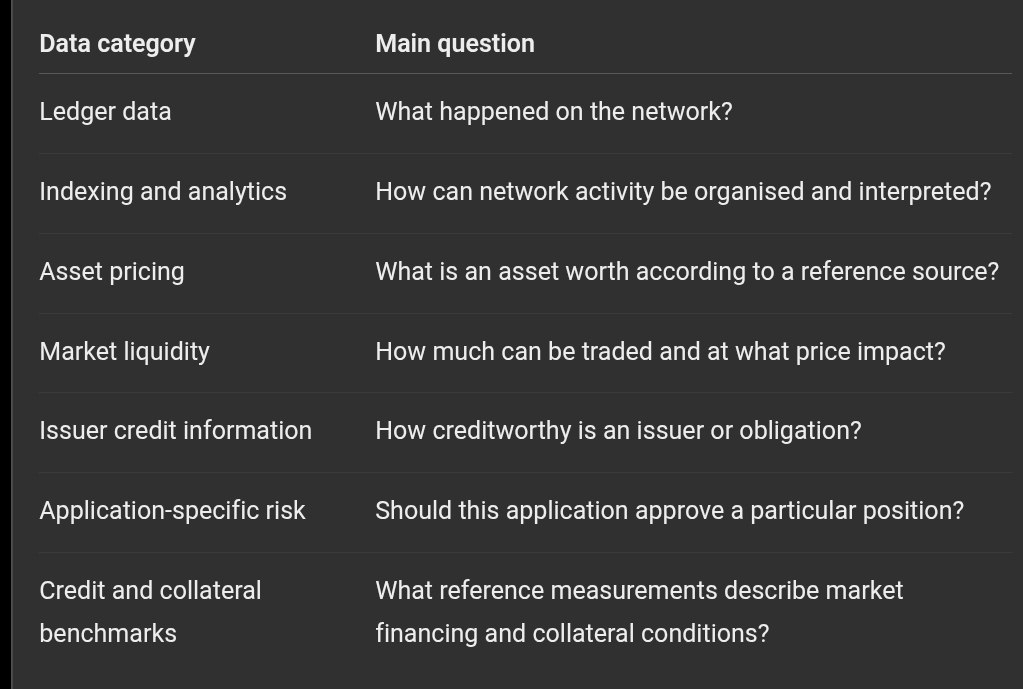
These categories are related, but they are not interchangeable.
A market price is not a measure of liquidation capacity. A credit rating is not a measure of executable collateral liquidity. An application's internal risk model is not necessarily a reusable benchmark for the wider ecosystem.
This does not establish that financial institutions on Canton lack sophisticated private risk systems. Such systems may exist without being publicly documented.
The more defensible observation is that the publicly visible ecosystem contains a growing range of specialised data services, while the development of independently governed, reusable market-credit and collateral benchmarks remains an area with further opportunity.
This becomes particularly relevant as lending, borrowing, collateral management, and institutional financing become more sophisticated.
The Role of Credit and Collateral Benchmarks
Financial markets depend on reliable reference information.
For secured lending, it is not enough to know the market price of collateral. Lenders also need to understand its liquidity, potential liquidation costs, borrowing conditions, and behaviour under stressed market conditions.
These factors can influence collateral haircuts, loan-to-value limits, financing costs, and the amount of credit a market participant can obtain.
Credit and collateral benchmarks can help organise some of this information into transparent, consistently calculated reference measurements.
They do not replace credit ratings, underwriting systems, or institutional risk models.
Instead, they can provide additional information that financial applications and market participants may use alongside their existing assessment processes.
For Canton, this is an interesting area of development.
The network is already supporting different financial applications and institutional data services. As those activities expand, specialised measurements of CC liquidity, financing conditions, and reward sustainability could become increasingly useful.
This is where a more specialised category of financial data begins to take shape.
Developing Credit and Collateral Benchmarks for Canton
Krasilnikoff Credit & Collateral (KC&C) is an emerging Canton-focused initiative developing measurements intended to provide greater insight into CC market liquidity, borrowing conditions, reward coverage, and tokenomics.
Its published methodology v0.14, effective for the November 13, 2026 sheet, outlines five principal benchmarks. The fifth, CC Burn/Mint Ratio, was introduced in November. https://www.krasilnikoff.cc/method
Liquidation Capacity
KC&C's Liquidation Capacity methodology examines visible bids across selected Tier A venues and estimates how much CC could be sold before the average execution price falls 2%, 5%, or 10% below the reference price.
The methodology samples visible bids every 15 minutes and calculates the daily median of observations from the preceding 24 hours. It also calculates stress capacity using the lowest 2% observation over the previous seven days.
Additional measurements include the estimated time required to sell 20 million CC and an illustrative maximum loan-to-value calculation based on volatility, selling time, and estimated liquidation costs.
This is relevant because collateral value is not determined by market price alone.
If a lender needs to liquidate collateral, the ability to sell the asset without causing significant price impact becomes an important consideration.
The methodology is a useful starting point because it considers market depth rather than relying solely on reported trading volume.
However, visible bids are not guaranteed executions. Orders can be cancelled, venues may become inaccessible, and actual liquidation outcomes can differ from modelled estimates. The methodology also acknowledges that some order-book cut-offs can make capacity a lower-bound estimate.
Independent execution validation will therefore be important. https://www.krasilnikoff.cc/method
Dollar Rate
The Dollar Rate measures the annualised borrowing cost of USDCx against CC through public on-ledger lending pools.
It weights the borrowing APY of each included pool by the amount of USDCx borrowed and reports utilisation alongside the rate.
At present, Alpend is the only public on-ledger pool represented in this measurement. KC&C states that bilateral desks such as Haven can be added when they publish suitable rates.
It should therefore be understood as an Alpend-based public on-ledger reference, not a complete market-wide dollar borrowing benchmark.
Expanding coverage across additional markets would strengthen its usefulness.
CC Borrow Rate
This benchmark measures the annualised cost of borrowing CC by taking the median of selected external exchange margin rates and the on-ledger Alpend borrowing rate.
Its methodology includes Bybit, Gate, Bitget, Kraken, and Alpend, with different collection procedures depending on the source.
For example, the exchange rates are calculated using hourly readings over the preceding 24 hours, while Kraken's published rate is entered manually because it does not provide the required API data.
This creates a useful reference, but it also combines different borrowing environments.
External exchange margin borrowing is not identical to borrowing through an on-ledger Canton lending pool. As the benchmark develops, users should be able to distinguish those components, their availability, and realised borrowing costs. https://www.krasilnikoff.cc/method
Reward Coverage
Reward Coverage is particularly relevant to the structure of the Canton ecosystem.
Some Featured Apps and ecosystem participants generate rewards through their activity. KC&C's methodology uses historical reward information to estimate a hypothetical standard credit line and assess how those rewards compare with the debt service required to repay it.
The methodology uses the ten Featured App parties with the largest activity weights as its reference group. It considers current and preceding 30-day reward periods, models a standard line based on three months of historical rewards, and calculates the median coverage ratio across eligible parties.
A value below 1× indicates that the modelled reward flow does not fully cover the standard line's debt service.
The underlying idea is that predictable reward flows may provide useful information when evaluating financing capacity.
This could become relevant for applications or participants exploring ways to use recurring ecosystem rewards in financing arrangements.
However, Reward Coverage is not a complete credit score or debt-service assessment. It does not establish that the parties have actually borrowed or can repay a loan. A stronger model would need to consider operating expenses, existing liabilities, reward volatility, concentration, repayment history, and changes in reward conditions.
Another limitation is that KC&C currently uses Lighthouse as an interim source for the relevant ledger data while direct access to the required Scan information remains unavailable to it. https://www.krasilnikoff.cc/method
CC Burn/Mint Ratio
Introduced in methodology version 0.14, this measurement examines the relationship between network traffic-related CC burns and estimated gross issuance over a defined period.
It provides an additional perspective on the relationship between network activity and token issuance.
There is an important methodological qualification: the traffic burn component is derived from Canton Scan MemberTraffic snapshots, while gross mint is inferred from changes in reported supply plus measured traffic burns. KC&C does not yet count all mint events directly, and its first version does not include every category of CC burn.
The methodology requires at least 27 valid days in a 30-day window. As of the November 13 methodology, the first full 30-day value was still being built and was expected on the November 28 sheet.
Although it is not a direct credit measurement, it contributes useful context to the wider economic conditions surrounding CC. https://www.krasilnikoff.cc/method
Together, these five measurements represent an attempt to organise different dimensions of CC market and financing information into a structured benchmark framework.
Evaluating the Methodology, Credibility and Readiness
KC&C's methodology is an important part of the initiative.
Its published methodology outlines the calculations, data sources, sampling procedures, quality controls, and limitations associated with its measurements.
The publication of these details is a positive development.
A benchmark should not simply present a number. Users should be able to understand what it measures, how it is calculated, and where its limitations lie.
KC&C also publishes methodology changes, corrections, and complaints procedures, giving readers a way to examine how its calculations evolve.
However, transparency is only one requirement for credibility.
There are several areas KC&C will need to strengthen as it develops.
Data coverage
Some measurements currently rely on a limited number of venues or lending markets. Broader and more diversified coverage would reduce dependence on individual sources and improve representativeness.
Independent validation
The liquidation methodology should be compared against actual execution outcomes. Reward Coverage should be tested against real financing and repayment performance. Borrowing-rate measurements should be compared with realised borrowing costs.
Governance and operational independence
KC&C's governance statement, dated November 7, 2026, discloses that the initiative is currently operated by its founder, who designs the methodology, manages data collection, performs calculations, and publishes the results.
There is no independent oversight committee or independent audit at present. KC&C acknowledges that one person cannot independently oversee their own work.
Its existing controls include published methodologies, version histories, raw data retention, quality gates, and public corrections. These are useful transparency measures, but they do not replace external review.
KC&C has stated that it intends to appoint an external reviewer when it obtains its first paid licence, enters into a contract or protocol parameter referencing its benchmarks, or issues its first credit line.
This is a sensible development direction, but the independence and effectiveness of such oversight will need to be demonstrated in practice. https://www.krasilnikoff.cc/governance
There is also a documentation issue worth addressing: the methodology governance policy still describes its scope as covering four benchmarks, although the methodology now publishes five. That policy should be updated to include the CC Burn/Mint Ratio.
Conflict management
KC&C has disclosed plans for 2027 to offer USDCx credit lines to Featured App teams and validators, as well as a collateral backstop that could purchase CC when a lending protocol cannot liquidate collateral through the market.
These activities could create a conflict between publishing market benchmarks and participating in the financial activities those benchmarks measure.
KC&C has published proposed separation rules, including restrictions on using its own benchmarks to set its own lending terms or collateral triggers.
Those safeguards will need to be independently reviewed and implemented before such activities begin. https://www.krasilnikoff.cc/governance
Institutional integration and licensing
KC&C has a public API and a partner access tier, while its institutional tier, including full history and a live stream of 15-minute observations, is planned for 2027.
Its terms also distinguish between reading data for internal analysis, redistributing it, and using it to set financial product or contract terms.
Internal use and limited research quotation are permitted with attribution. Redistribution requires a licence, while using its values to determine loan terms, collateral parameters, financial instruments, or smart-contract rules requires prior written consent and a licence.
This is an important distinction. Technical access to a benchmark does not automatically provide commercial permission to integrate it into a financial product. https://www.krasilnikoff.cc/terms
These are important development requirements, not reasons to dismiss the initiative.
At this stage, KC&C is best understood as an emerging Canton Coin credit and collateral data provider developing methodology-driven market benchmarks.
Its long-term credibility will depend on the quality of its data, the reliability of its calculations, the independence of its governance, and evidence that its measurements are useful in real financial applications.
The Potential Impact Across Canton
The development of a stronger credit and collateral benchmark environment could create benefits across different parts of the Canton ecosystem.
For Validators and Super Validators
Transparent indicators of CC liquidity, financing conditions, and reward sustainability could provide additional information about the economic environment surrounding the network.
They could also contribute to a more structured understanding of liquidity and financing conditions. These measurements would complement, rather than replace, the operational and financial assessments validators already perform.
For lending applications
Applications could use independently produced liquidity and financing indicators alongside their own risk models.
For example, liquidation-capacity information could provide an additional reference when evaluating collateral parameters, while borrowing-rate benchmarks could help compare financing conditions.
For institutional participants
Institutions require financial information that can be explained, independently assessed, and incorporated into existing risk processes.
Well-governed benchmarks with documented methodologies and reliable data sources could help provide that foundation.
For data providers
A more connected benchmark environment could create opportunities for collaboration between existing data and analytics providers.
The objective should not be to replace or centralise all existing data services, but to make their different contributions more useful within financial workflows.
The long-term value would come from better information supporting better financial decisions, not simply from adding another dashboard to the ecosystem.
What Comes Next?
Canton's next stage of data infrastructure development should focus on quality, interoperability, and practical financial use.
One opportunity would be to establish clearer disclosure expectations for financial data and benchmarks across the ecosystem.
These could cover the purpose of each measurement, its underlying sources, coverage, update frequency, calculation methodology, limitations, governance, and permitted use.
A public registry of data providers and benchmarks could also make it easier for institutions and applications to understand what information is available.
Existing providers could explore ways to make their services complementary, particularly where data access, pricing, market intelligence, and specialised financial measurements intersect.
For KC&C, the immediate priorities should be strengthening governance, expanding data coverage, validating its measurements, and developing institutional-grade access.
Most importantly, the benchmarks should be tested through actual financial applications.
Liquidation-capacity measurements could be compared against realised execution outcomes. Reward Coverage could be tested against actual repayment performance. Borrowing-rate indicators could be compared with realised financing conditions.
The results would help establish whether these measurements improve financial decisions rather than simply adding another layer of market information.
Canton's data infrastructure has developed from its native network interfaces into a broader ecosystem of indexing services, analytics providers, institutional reference data, oracles, market intelligence, and financial applications.
Each layer contributes something different.
The next challenge is to ensure that these capabilities can support increasingly sophisticated financial activity with reliable, transparent, and useful information.
Credit and collateral benchmarks represent one opportunity within that evolution.
KC&C is an emerging initiative attempting to contribute to this area through a structured set of CC-focused measurements. Its potential will depend on its ability to move beyond publishing methodologies towards independent validation, broader coverage, credible governance, and practical integration.
Ultimately, the evolution of Canton data infrastructure should be measured not simply by how much information is available, but by how effectively that information can support real financial decisions.