
Wallet, operator and governance updates from November 12–13. Source.
Edel has reported a theft of EDEL tokens, Cantex has added optional two-factor authentication, and Console Wallet says its services are restored. This roundup also covers Canton 3.7.3, new development-fund decisions and proposed standards.
Updates from November 12–13, including items published before the previous roundup but not covered there. Checked through November 13, 2026 at 14:10 UTC.
Edel reports $300,000 in stolen tokens
Edel reported the theft of approximately $300,000 worth of EDEL tokens on November 12. The project said it was working with authorities and exchanges to investigate.
In a follow-up that day, Edel said all the stolen tokens had either been sold or blocked by exchanges, and promised a detailed post-mortem. It did not give a breakdown between the two outcomes, so the notice does not establish that the full amount was recovered.
The notices concern the EDEL token. They do not identify the affected wallets or establish that Canton’s network or Edel’s other products were compromised.
Wallet access and security
Cantex adds optional two-factor authentication. The wallet update covers withdrawals, transfers, pre-approvals and bridge transactions. Two-factor authentication adds another check beyond the initial sign-in. Here, users can choose to apply it to actions that move assets or grant permissions.
Console Wallet reports full service restoration. In its November 12 update, Console said it was fully operational after a precautionary suspension following suspicious activity the previous week. The restoration is the project’s reported status; the short notice does not provide a full incident analysis.
Canton 3.7.3: fixes with upgrade work attached
The November 12 maintenance release addresses a resource leak that could increase sequencer CPU and memory use over several days. A sequencer is part of the infrastructure that orders and distributes messages used to coordinate Canton transactions.
The release also tightens checks around party replication, the process of bringing a participant’s contract data onto another node. Operators should read the upgrade notes before applying it: changes affect experimental traffic top-ups, replication rules and monitoring labels. Publication of a release does not mean every MainNet operator has upgraded.
Two development proposals pass their votes
Python tools for application teams. Obsidian Systems’ 1.27 million CC proposal passed and was merged. It would generate Python classes from compiled Daml packages, saving developers from recreating those contract definitions by hand. The plan includes delivery and a year of maintenance. It follows the earlier vote opening.
A protected co-validator. Financial Privacy Inc.’s proposal also passed and was merged. It requests 4.59 million CC to develop a Canton participant inside a trusted execution environment, or TEE: a protected area of a computer designed to keep data and execution isolated from the machine’s operator.
The intended benefit is an additional transaction confirmation without giving another operator ordinary access to the participant’s private data. The project covers development against DevNet and TestNet, a reference deployment and maintenance. The vote does not establish a completed production service.
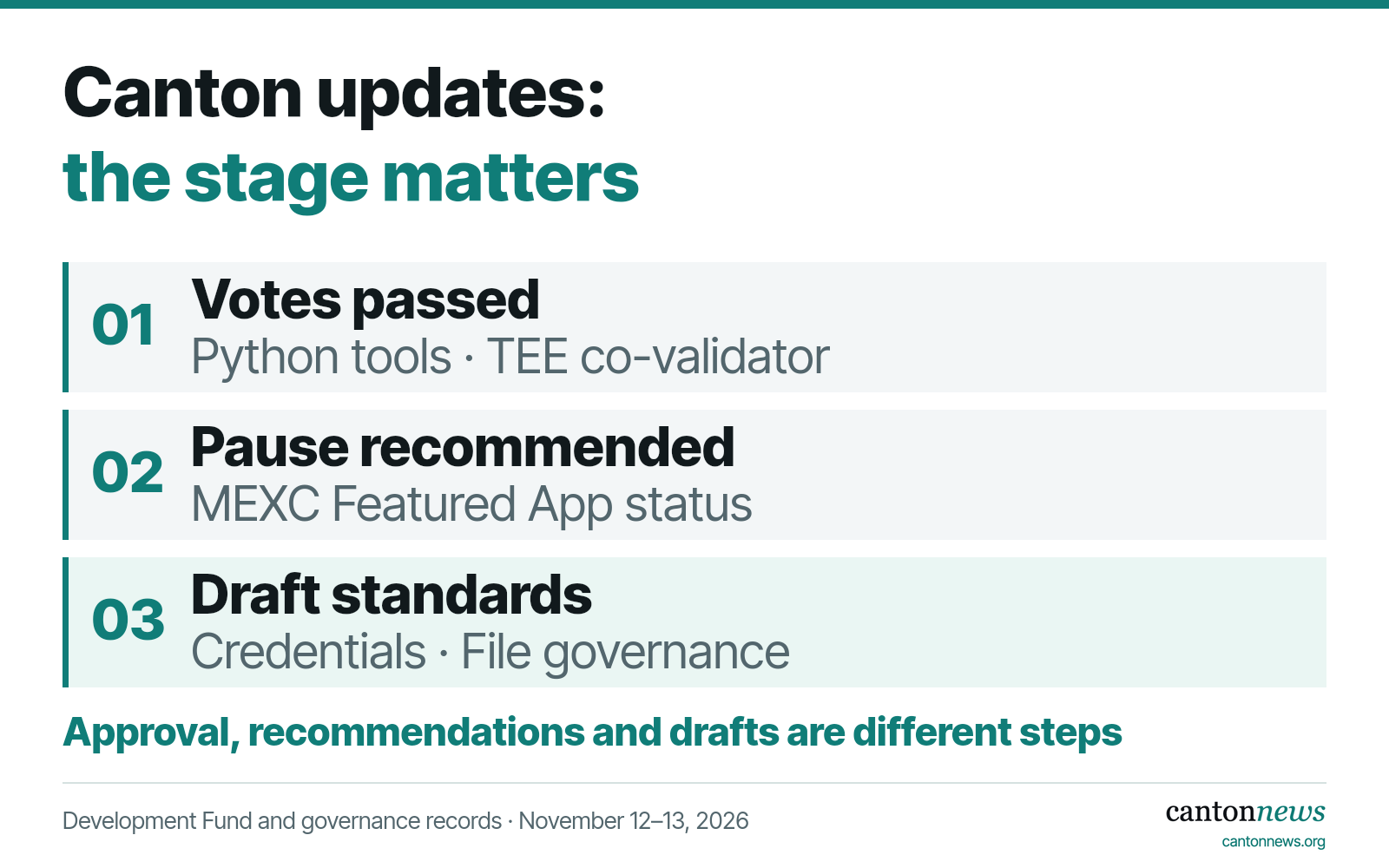
Different stages in the latest Canton updates. Source.
MEXC Featured App status: a recommendation to pause
The Tokenomics meeting outcome published November 12 says MEXC’s Featured Application is not compliant with CIP-0116 locking requirements and recommends pausing its status. It identifies GSF as the Super Validator for the on-chain vote.
Featured App status concerns the application’s treatment under Canton’s rewards framework. This notice should not be read as an announcement that MEXC exchange trading has stopped, or as confirmation that the on-chain status change is already complete.
A demonstration of on-chain CC locks
The same bulletin links a Governance Locks demonstration and documentation showing how Super Validators and Featured Apps can create and manage CC locks. It follows CIP-0127’s approval. The demonstration explains the workflow; it is not, by itself, confirmation of network-wide enforcement.
Security tooling and standards under discussion
Dedaub seeks a champion for DamlSec. Its revised proposal under RFP 22 would check compiled Daml packages for security problems before deployment. Dedaub says the original request was closed during the Development Fund transition. The revised submission remains a proposal, with no new approval established.
PixelPlex proposes shared credentials. The Canton Credentials draft aims to give apps a consistent way to identify a party and the services it operates. The team is validating a reference implementation and seeking feedback.
Lighthouse asks how shared contracts should reference files. Its File Governance discussion draft focuses on checking that two institutions refer to the same document and can detect changes, while keeping their own storage systems. It seeks technical feedback and sponsorship to advance through the CIP process. The draft asks for neither code delivery nor funding.
Primary sources: Canton 3.7.3 release notes, Tokenomics outcomes and the project announcements and proposal records linked above.