
Canton Strategic Holdings, Q3 2026 financial results. Source. Graphic by CantonNews.
Canton Strategic Holdings reported $3.05 million in third-quarter revenue, up 104% from the previous quarter, as its Canton Network validation and coin-locking businesses completed their first full quarter of operations. Revenue exceeded operating expenses, producing $340,591 in operating income.
The Nasdaq-listed company, which trades as CNTN, also recorded its first positive quarterly adjusted EBITDA of $610,414. It still reported a $35.08 million net loss, with a decline in the value of its Canton Coin holdings weighing on the result.
Where the revenue came from
For the three months ended September 30, revenue totaled $3,051,232, compared with $1,495,859 in the second quarter. The two revenue lines were:
- Network validation: $1,503,238, up from $191,226 in Q2. The company earned 13.23 million CC through its Super Validator operations during the quarter.
- Other revenue: $1,547,994, up from $1,304,633. This included $1,472,863 from locking-as-a-service and $75,131 in net gains on CC option contracts.
A Super Validator helps operate Canton's shared infrastructure and participates in its governance. Its reward weight determines its proportional entitlement to newly minted CC allocated to Super Validators. Canton Strategic's active weight rose from 0.5 at June 30 to 6.5 at September 30, helping explain the increase in validation revenue.
Its locking service earns compensation by committing company-owned CC on behalf of network participants that must meet coin-locking requirements. Canton Strategic retains ownership of those coins. Most locking-service customers pay in CC, so recognized revenue is not the same as cash received in a bank account.
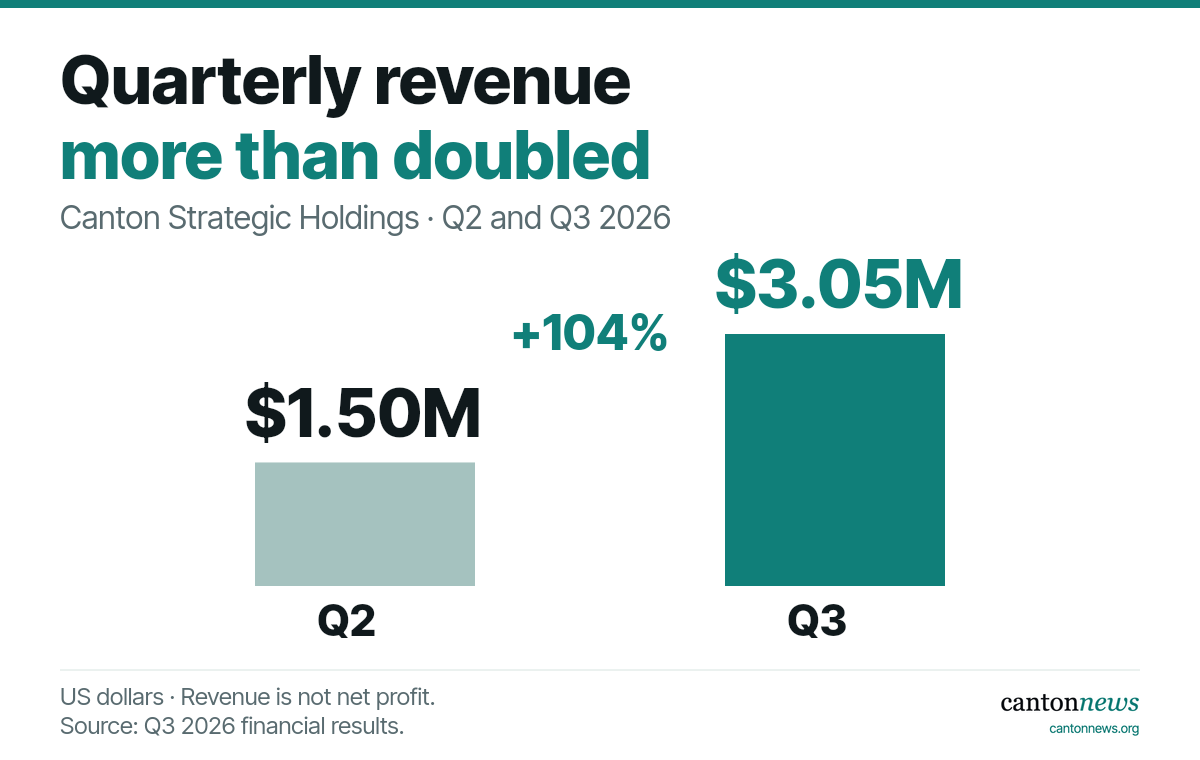
Revenue for the quarters ended June 30 and September 30, 2026. Source: financial results.
Operating income improved, but the net loss widened
Operating expenses were $2,710,641, up just 0.5% from Q2. Revenue grew faster than those costs, moving the business from a $1.20 million operating loss to $340,591 in operating income.
The larger influence on the bottom line was a $54,648,199 unrealized loss on digital-asset holdings. An unrealized loss reflects a change in the value of assets still held, rather than a loss from selling them. The quarter's net loss was $35,078,297, compared with $19,254,826 in the Q2 filing. The Q3 result also included an income-tax benefit and income from discontinued operations.
What does adjusted EBITDA mean here? It is the company's supplementary, non-GAAP measure of performance. Its reconciliation excludes items including unrealized digital-asset gains or losses, tax effects and discontinued operations, while retaining interest earned on cash and cash equivalents. The positive $610,414 figure therefore does not mean the company made an overall net profit or generated that amount of cash.
More coins, a lower quarter-end valuation
The September 30 balance sheet and digital-asset note show:
- CC held: 3,833,830,293 coins, up 3.2% from 3,714,204,876 at June 30.
- Fair value of the holding: $482.15 million, down from $523.35 million despite the larger coin balance.
- Cash and cash equivalents: $26.92 million, compared with $37.24 million at June 30.
- Total assets: $513.93 million; stockholders' equity: $420.68 million.
These are quarter-end figures, not the value of the treasury today. They show why a larger CC holding and stronger operating revenue can coexist with a lower asset valuation and a net loss.
What remains conditional
Canton Strategic has 15 approved Super Validator weight in total, of which 6.5 was active at September 30. It expects the remaining 8.5 to become available through the first quarter of 2028. The schedule depends on completing required work, maintaining qualifying CC holdings and passing the applicable Canton Foundation reviews.
For the next results, the useful comparisons will be validation and locking-service revenue, the cost of running those businesses, and the changing value of the CC treasury. Higher approved weight gives the company a route to more reward participation, but the unreleased weight is not yet active and does not guarantee a dollar return.
Sources: Q3 financial and operational results, Q3 Form 10-Q and Q2 Form 10-Q.