
Canton market and developer updates, November 13–14, 2026.
Canborsa has announced two Anthropic-linked trading markets, while The Tie has published a new year-to-date Canton Coin burn figure. For developers, votes have opened on tools for testing contracts, planning upgrades and making ledger data easier to use.
This edition covers November 14 funding votes and November 13 market updates not included in the previous Canton Roundup. Reporting cutoff: November 14, 2026, 20:01 UTC.
Canborsa adds Anthropic-linked markets
Canborsa announced ANT and ANTH markets on November 13, listing leverage of up to 10x for both on Canborsa Perps. Anthropic is the company behind Claude.
What are perpetuals? They are trading contracts that let users take a position on price movements without a fixed expiry date. A position in one of these markets does not give the trader ownership of Anthropic shares. Leverage increases exposure, so it can amplify losses as well as gains.
The announcement adds another category of exposure to a venue that already supports Canton Coin as collateral. The tickers and leverage limits above are those stated by Canborsa.
The Tie puts this year’s CC burn at 4.49 billion
The Tie reports that 4.49 billion Canton Coin were burned between January 1 and November 11, 2026.
Burning means permanently removing tokens from circulation. Canton Coin pays for traffic on the Global Synchronizer, the shared service that helps Canton applications coordinate transactions. Those traffic payments burn CC.
The figure is a year-to-date total. It does not measure the net change in supply, which also depends on newly minted rewards.
DamlFuzz: testing for problems before users find them
A funding vote opened on DamlFuzz on November 14. The proposal would give developers a free, open-source tool to test contracts written in Daml, Canton’s smart-contract language.
A fuzzer tries many inputs and sequences of actions to uncover failures. For Canton applications, that includes checking rules about who can authorise an action and which parties can see the data. The proposed tool would run locally and fit into developers’ regular testing.
A planner for safer application upgrades
A separate vote opened on the Party-Aware Daml Upgrade and Vetting Planner. The aim is to help teams work out whether an application update is ready before they change a running system.
It would combine checks on software packages, dependencies and permissions into a reviewable plan. Vetting is the process of declaring which application packages a participant supports.
The proposed first version would inspect one participant and produce a plan without making changes itself. Where information is missing, it would flag the gap rather than treat the whole network as ready.
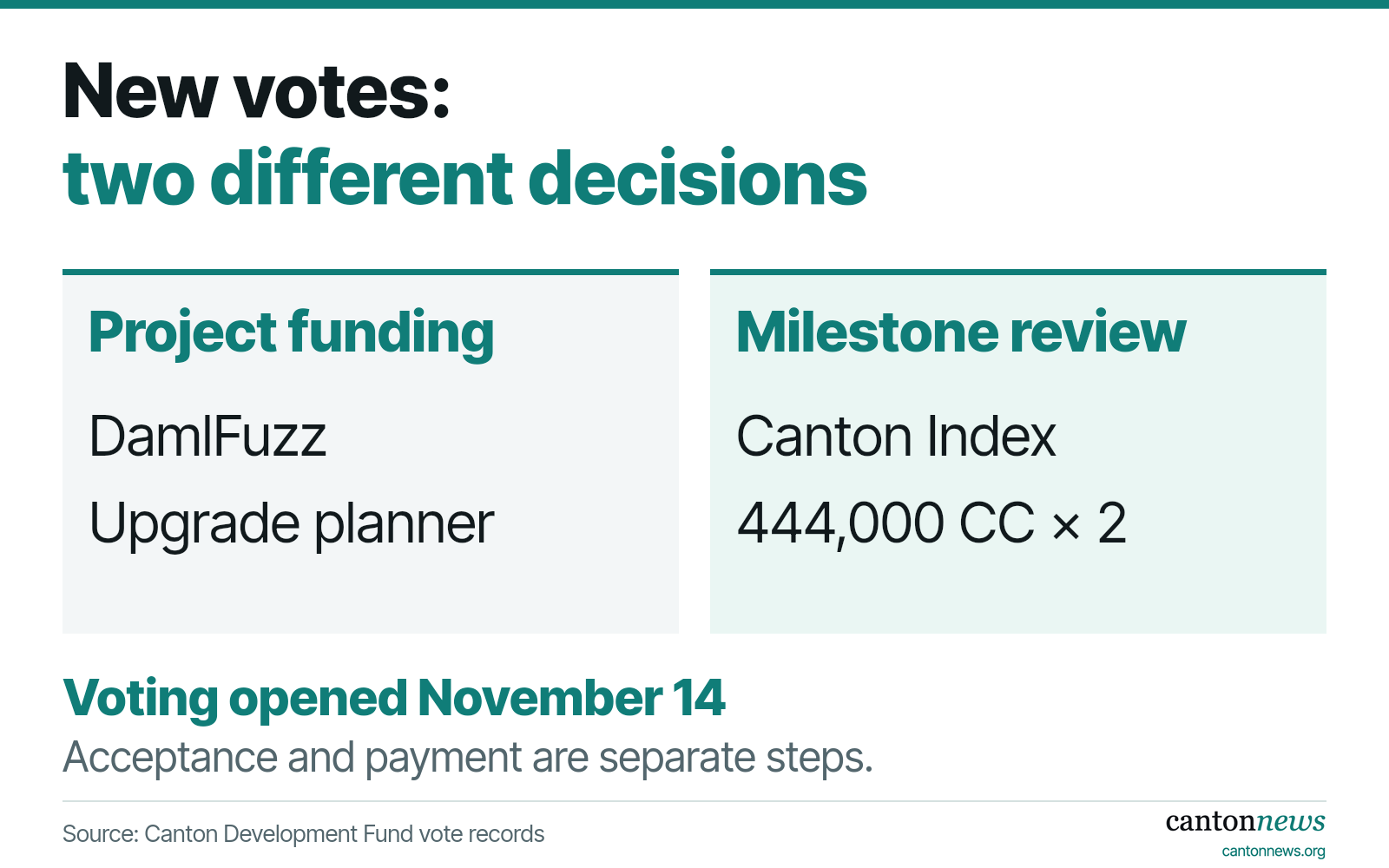
November 14 votes: DamlFuzz, upgrade planner and Canton Index.
Canton Index returns for milestone review
Canton Index, a project from The Graph Foundation and InfraDAO, aims to turn ledger records into data that applications can query more easily. Votes opened on two parts of that work:
- Milestone 1: tools for defining and testing filters that select the records an application needs.
- Milestone 2: a pipeline that processes new ledger records and keeps the application’s stored data up to date.
Each milestone carries 444,000 CC, for a combined 888,000 CC. These are votes on acceptance of submitted work, rather than a new award for the entire project.
The first milestone is returning to review after an earlier vote did not pass. In its resubmission, the team describes revised documentation and responses to design feedback. It also says the source code remains private, with publication planned by milestone 4. Neither of the new votes had established acceptance or payment at the reporting cutoff.
Kann Audits proposes two security projects
Kann Audits submitted two applications on November 14:
- Independent audits of core components. Kann seeks assignments within the existing audit programme. It requests no new allocation; individual audits would draw on that programme’s approved budget, subject to selection.
- AI-assisted Daml security scanning. This request seeks the CC equivalent of US$45,000 over nine months. The plan includes a catalogue of security weaknesses, developer-tool integration and three months of free access for each Canton team, with a researcher reviewing its first scan.
Both applications still list a need for a champion to support them through the process. They are proposals, not approved grants or audit appointments.
Sources: Canborsa, The Tie and the linked Canton Development Fund records.