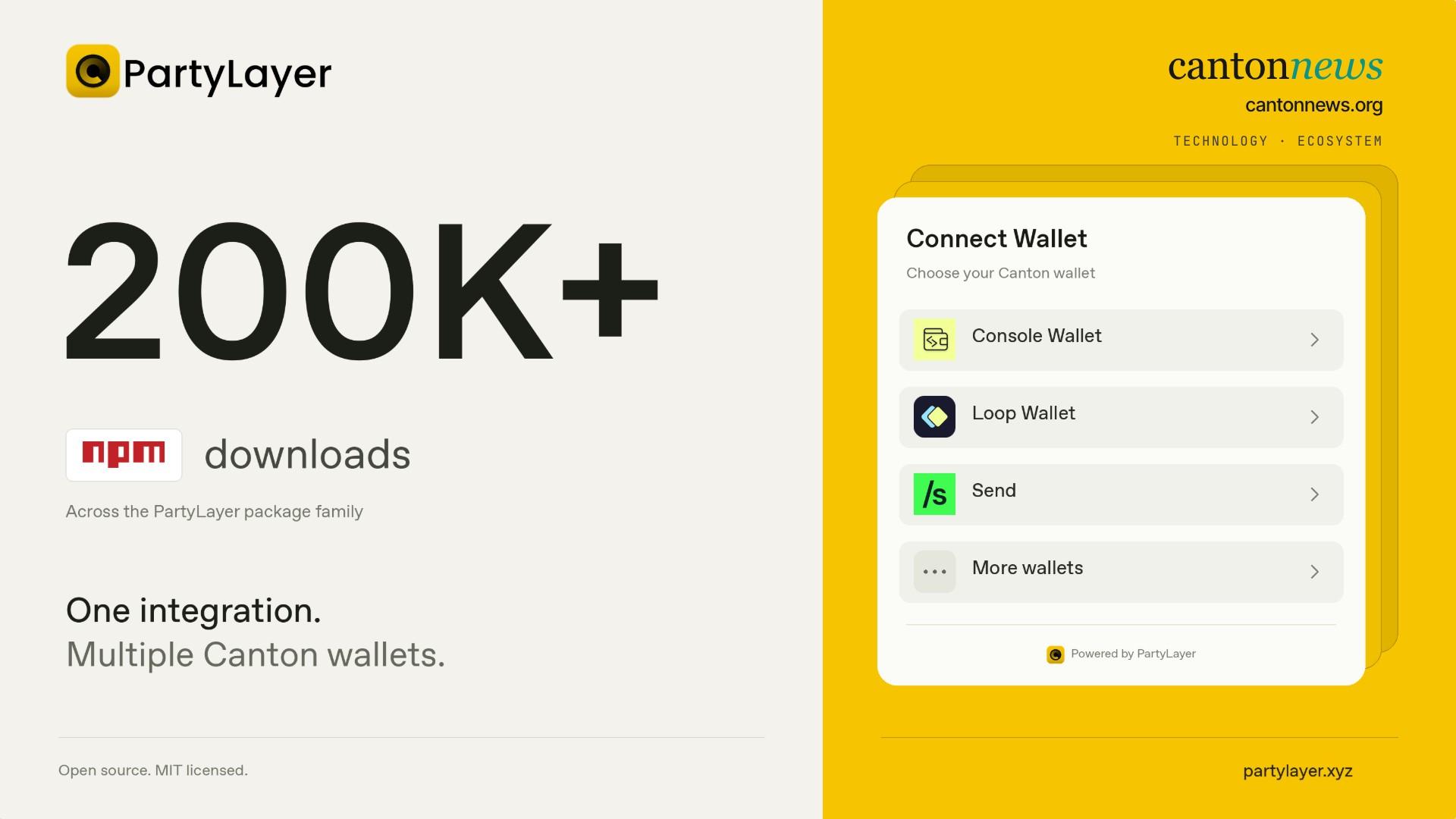

PartyLayer has surpassed 200,000 cumulative downloads across its npm package family as it expands its open-source developer toolkit for Canton Network. The project also reports nearly 100,000 unique visitors and more than 2 million web requests to partylayer.xyz over the past 30 days.
The download milestone follows CantonNews’ August report on PartyLayer passing 106,000 downloads. Since then, the project has shipped updates across several roadmap priorities, including simpler onboarding, wallet-based application sign-in and mobile development.
Developed by Cayvox Labs, PartyLayer helps teams avoid rebuilding the same wallet connection and interface code for each application. It builds on Canton’s shared standards with libraries, ready-made components and integration examples that developers can adapt to their own products.
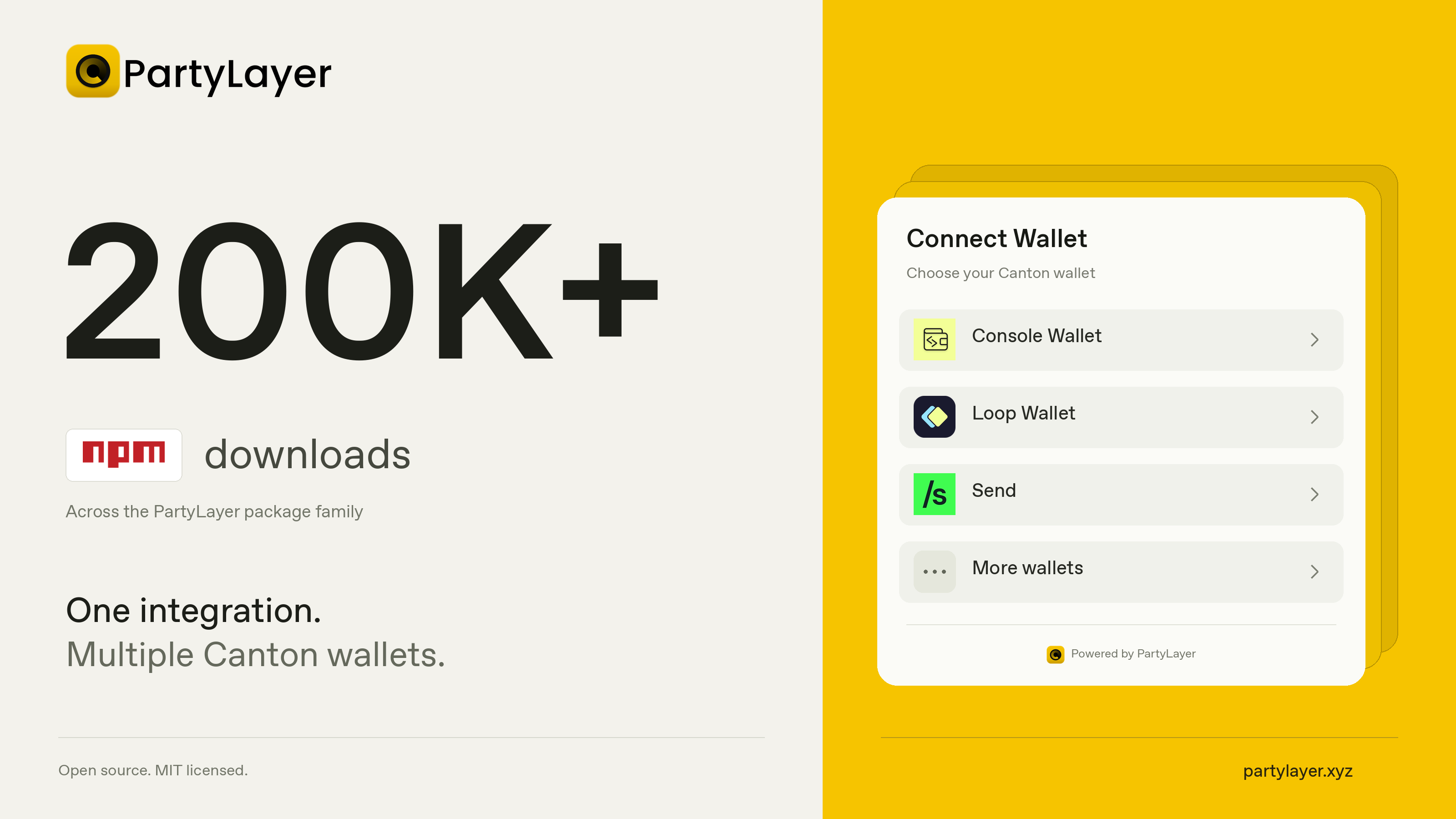
A shared wallet experience with one installation
PartyLayer’s React package includes the SDK, supported wallet runtimes, a Connect Wallet button, a wallet selection modal and an account menu. Developers can install the required packages with a single command:
npm install @partylayer/react @tanstack/react-query
They then add the PartyLayer components to their application to enable the connection interface. No separate PartyLayer package is required for each wallet, and themes and appearance can be configured to match the application.
For new projects, the command-line tool offers six starter templates, including React/Vite and Next.js. The quick-start guide covers both adding PartyLayer to an existing application and creating a new project.
From wallet connection to application workflows
Recent releases extend the toolkit into the experiences users need after connecting a wallet:
- Interfaces in 14 languages. Connection and operation components support automatic browser-language selection, English fallback and right-to-left layouts for Arabic.
- Reusable transfer components. Teams can add interfaces for reviewing and submitting transfers and responding to incoming transfers. These components share the existing wallet session, theme and language settings while remaining configurable for the application’s token and ledger workflows.
- Wallet-based application sign-in. Authentication hooks, server-side helpers and a runnable PostgreSQL reference implementation help developers connect wallet signatures to their own backend authentication systems.
- Resources for AI coding assistants. Plain-text API references and integration guides provide current context on PartyLayer’s public APIs, configuration and usage.
- An updated mobile package. React Native 2.0 separates native dependencies from browser wallet code and documents setup for both native and web applications.
Current releases include SDK 0.22.1, React 3.4.0 and React Native 2.0.0.
Built on Canton’s shared standards
PartyLayer complements CIP-0103 and Canton’s official wallet discovery infrastructure with tools for application developers. Browser-native CIP-0103 connections use the official discovery infrastructure, while PartyLayer provides ready-made interfaces, React hooks, session management and libraries for multiple application frameworks.
The wallet catalog includes Console Wallet, Send, 5N Loop, Cantor8, Nightly, Walley, Cauri and OneSwap. Vala is available through the Devnet beta channel, while WalletConnect is enabled through application-provided configuration. Available wallets depend on the selected network, channel and each wallet’s supported capabilities.
This shared interface accounts for differences between wallets. Application sign-in requires server-side verification, while transfer workflows distinguish wallet approval, transaction submission and independent confirmation of the ledger result.
Open development with public release evidence
The source for PartyLayer’s November 15 corrective release passed 2,277 workspace tests and 210 browser interface tests across Chromium, Firefox and WebKit. Post-publication checks also covered clean public npm installations, React/Vite and Next.js production builds, and React Native Metro bundles.
Public release records on GitHub document these checks and the cryptographic verification linking published packages to their source and publishing workflow. The records also distinguish completed automated checks from separately tracked validation, including funded live-wallet transactions and physical-device testing.
PartyLayer’s ongoing development focuses on easier project setup, wallet compatibility, practical integration examples and mobile tooling for Canton applications.
Developers can explore the toolkit at partylayer.xyz, follow the documentation or contribute through GitHub.
About PartyLayer
PartyLayer is an MIT-licensed, open-source wallet integration toolkit for Canton Network applications, with packages for TypeScript, React, Vue and React Native. It is developed by Cayvox Labs, which builds open-source infrastructure for the Canton ecosystem.