
Supanova V2, November 2026. Graphic by CantonNews.
Supanova introduced V2 on November 17, highlighting three things users can do through its Canton launchpad: bridge into Canton Coin, trade from a phone and launch a token.
The update follows the launchpad’s November 3 opening. For individuals and communities exploring Canton, the useful question is how to get funds into the app and move from finding a token to trading or creating one.
Three routes to fund an account
Supanova’s current launchpad guide describes three ways to add CC:
- From an exchange: send CC from a supported exchange.
- From another chain: use USDC, USDT or ETH through the Squid route described in the guide.
- From a Canton wallet: send CC to the account’s Party ID, the identifier used to address a participant on Canton.
The guide separates Funding from Trading. Incoming CC arrives in Funding and must be moved to Trading before it can be used to buy launchpad coins. That extra step is useful to know when a deposit has arrived but is not yet available in the trading balance.
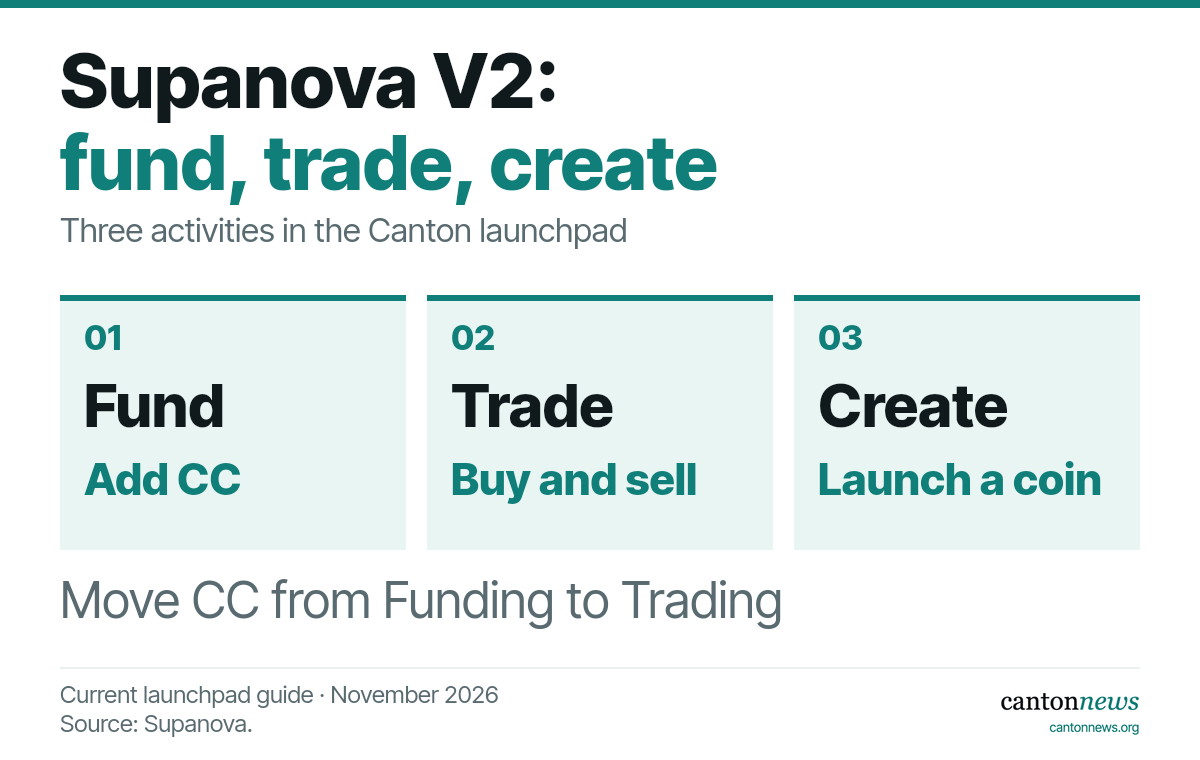
The launchpad’s three main activities. Source: Supanova guide.
What creators and traders pay
The launch guide lists a 25 CC creation fee. A creator supplies a name, ticker and image, after which the token begins trading on a bonding curve. A ticker is the short label used to identify the token; a bonding curve is a formula that changes its trading price as people buy and sell.
The guide states that each trade includes a 1% fee. That is a trading charge, separate from any costs associated with bringing funds into the app. The guide says creators receive 80% of that trading fee, both on the curve and after the pool opens.
For example, a 1,000 CC trade with a 1% fee produces a 10 CC fee, of which 8 CC goes to the creator. This is an illustration of the stated split, not a measured trade or promised creator income.
At the guide’s threshold of 250,000 CC raised on the curve, the curve completes. Trading pauses while an open liquidity pool is created, then continues from the same coin page. A liquidity pool holds the assets against which users trade after graduation.
How V2 fits the existing launchpad
The public app groups discovery, swaps, pools, the wallet and token creation into one interface. Its announcement places mobile use and access to CC alongside the creator tools that were already central to the original launch.
Memecoins remain speculative, and thin liquidity can make selling difficult. Completing the bonding curve establishes a trading pool; it does not guarantee demand or protect a token’s value.
Official links
Supanova launchpad · Funding, fees and launch mechanics · Documentation · Supanova on X
Sources: V2 announcement and current launchpad guide. Product details checked November 18, 2026.