
Palladium Labs has open-sourced canton-oracle-kit, a set of Daml contracts and supporting tools that helps Canton applications verify Chainlink price reports and keep usable prices on the ledger.
The team announced the release on November 18, describing it as the oracle path used by Alpend on Canton MainNet. Version 1.0.0 includes a report-verification contract, a price store, an example updater and documentation for deployment and operations. Palladium’s code is available under the Apache 2.0 licence. Release announcement, public repository
For builders, the intended benefit is less repeated integration work. A lending market needs prices to value collateral and calculate borrowing capacity. Getting those prices into an application involves checking their authenticity, age and suitability for the transaction using them.
How a signed report becomes a usable price
Chainlink Data Streams delivers market data in reports signed by its oracle nodes. Chainlink’s Canton integration provides contracts that check those signatures against a Chainlink-issued configuration containing the authorised keys. Chainlink’s integration guide
Palladium’s kit connects that verification step to a price store. An off-ledger program, called the pusher, fetches a signed report and submits it to a Daml feeder contract. The feeder calls Chainlink’s verifier, decodes the report, checks its validity window and passes the price to the store.
Applications can then read the stored price within their own contract logic. The repository includes an example that values a holding by multiplying its quantity by the current price, showing how the data can feed into a financial calculation. Architecture and example
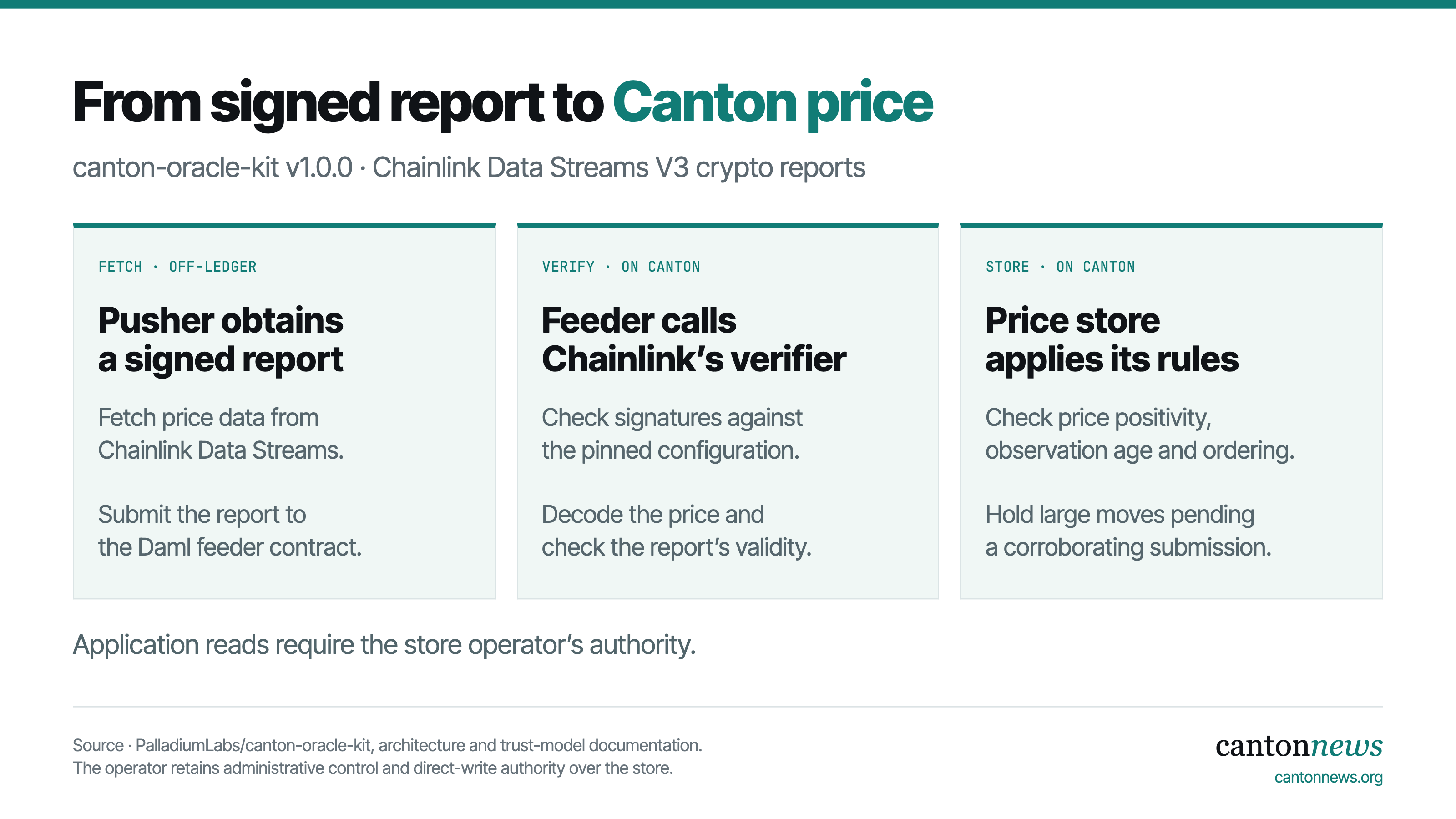 The price-ingestion path in canton-oracle-kit. The trust model gives the application operator administrative and direct-write authority.
The kit currently supports V3 crypto reports. Developers also need Data Streams access and a Chainlink-issued verifier configuration for their Canton party. The example pusher targets Node.js 22, while the published compatibility table lists Daml SDK 3.4.11 and Canton 3.4.x. Compatibility and onboarding
Rules for stale prices and sharp moves
The price store applies several checks before accepting an update. Prices must be positive, observations must fall within the configured age limit, and the observation timestamp must be newer than the active price’s timestamp.
It also puts a price move above a configured threshold into a pending state. A subsequent submission can activate the new value when it corroborates the pending price within the required freshness window. During that wait, the previous active price remains available subject to its age limit.
That introduces a delay during genuine sharp market moves. Applications therefore need to choose their freshness and deviation settings around the decisions those prices support, particularly collateral valuation and liquidation. Price-store rules
The pusher includes controls for updates triggered by price movement or elapsed time, alongside monitoring for failed fetches and prices that stop refreshing. These give developers a starting point for operating the feed after deployment. Example pusher
The operator still has a central role
The design gives the pusher and the application operator different permissions. The pusher submits reports through the verification path. The operator controls the trusted verifier configuration, feed mappings and administrative changes.
The operator also retains authority to write prices directly or recreate the store. The kit’s trust model therefore places responsibility on operator key controls and monitoring the transaction history to confirm that price changes followed the intended verification path. Documented trust model
Price reads are operator-controlled too. A consuming application needs the store operator’s authority in its Daml contract flow. Developers must also track the current store identifier, which changes with each update. Integration limitations
Production experience and the audit scope
Palladium says Alpend uses the oracle path in production. That follows the Chainlink Data Streams integration we covered in May, when Alpend and Raven Market described pricing uses in credit and options markets. Our earlier Chainlink coverage
The repository links to Halborn’s Alpend assessment. That report covers an Alpend code snapshot reviewed in June, including its Chainlink oracle integration, and records all reported findings as addressed. The current kit separately documents live-participant testing of initial verifier validation and verifier rotation as outstanding work. Halborn’s assessment, kit limitations
The release also continues Palladium’s support for Canton developers. In June, we covered its Genesis Fund for applications, infrastructure, tooling and research. The oracle kit makes one specific part of that engineering work available for other teams to inspect, adapt and integrate into their own applications. Our Genesis Fund coverage