
Canton ended September with more recognised applications, six new Super Validator approvals and CC burns covering a larger share of newly minted coins. It also recorded lower fee totals and transaction activity than in the previous quarter.
Those are the main findings of Canton Strategic Holdings’ Q3 ecosystem report. The review brings together network figures through September 30 with developments in trading, institutional participation and infrastructure.
More applications did not mean more transactions
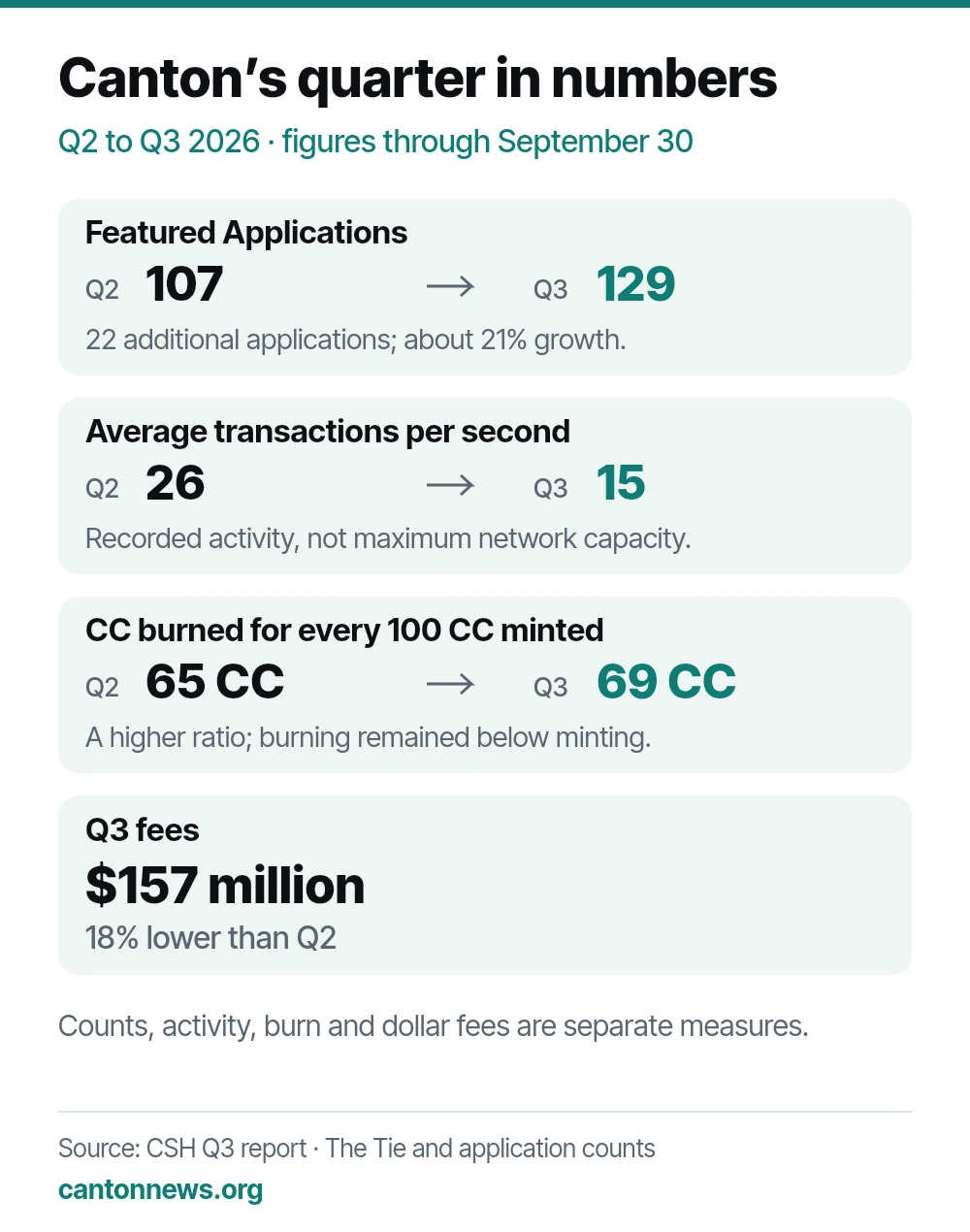
The Featured Application count rose from 107 at the end of June to 129 at the end of September. That is 22 additional applications, an increase of about 21%.
At the same time, average transaction activity fell from 26 to 15 transactions per second. Q3 fees were $157 million, down 18% from Q2. These figures describe recorded activity, not the network’s maximum capacity.
The report points to tighter activity standards and changes to reward accounting as possible contributors to the decline. More recognised applications did not translate into more recorded transactions during the quarter.
Burns covered more of minting
Canton Coin is burned to pay network fees, while rewards create new coins for eligible participants. In the report’s quarter-by-quarter comparison, the burn-to-mint ratio rose from 0.65 in Q2 to 0.69 in Q3.
A ratio of 0.69 equates to roughly 69 CC burned for every 100 CC minted, compared with 65 at a ratio of 0.65. The proportional shortfall was smaller, although minting still exceeded burning.
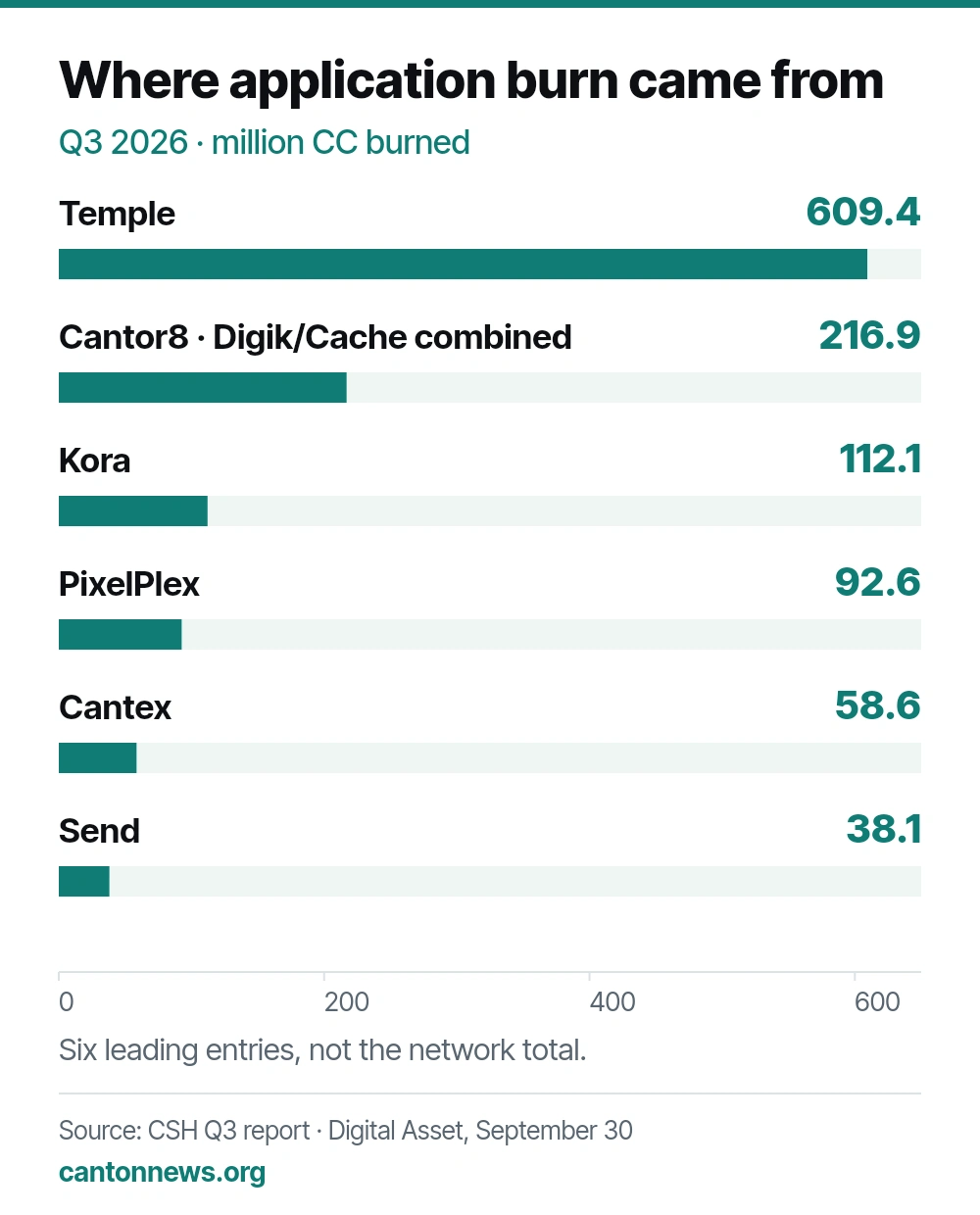
Trading venues generated nearly half of the quarter’s CC burn. Temple led the report’s application ranking with 609.4 million CC, followed by Cantor8’s combined Digik/Cache entry at 216.9 million and Kora at 112.1 million.
Institutional deals and trials
The six Super Validator approvals were a16z crypto, London Stock Exchange Group, Marex, Paxos, Shinhan Asset Management and TreasurySpring. These were program approvals, rather than announcements that all six had begun operating.
Other developments showed how tokenized assets can be used. DTCC’s July production transactions involved more than 30 firms and included collateral pledges, securities lending, Treasury repo and equity transfers. That event covered both Canton and DTCC’s private Besu network, so the participation total is not Canton-only.
In August, the USDM1 sovereign-bond repo used a digitally issued Marshall Islands bond in a short-term financing transaction. Repo involves selling an asset with an agreement to buy it back later. This gave the bond a practical role beyond simply existing as a token.
Japan’s MUFG government-bond repo pilot was launched to explore automating financing and settlement involving Japanese government bonds. The work was a proof of concept, not a commercial launch.
The tools and incentives behind the activity
Broadridge launched DLX in September, bringing together tools for issuing, trading, settling, holding and servicing tokenized assets. For institutions, that matters because a new asset must fit into existing operations before it can become routine business.
Canton was also changing how eligible application rewards are calculated. CIP-0104 is intended to replace self-reported activity markers with measured network traffic. The transition was not complete when the report was written, so its intended benefits should not be treated as fully delivered Q3 results.
The Foundation also funded shared tools and infrastructure. Its first fund report recorded 62.2 million CC paid or minted against accepted work by August 24. That was cumulative, not spending in Q3 alone.
What matters next
In our view, Q3’s strongest examples are transactions that give tokenized assets a purpose: borrowing against a bond, transferring collateral or settling a trade. More applications and institutional approvals widen the range of services being built. Repeated use will show which of them become useful businesses.
DTCC’s broader launch, planned for October, will be one test of that progress. July demonstrated individual transactions; the next question is whether participants begin using the service regularly.
Canton Strategic Holdings holds CC, operates as a Super Validator and invests in the ecosystem. Its report therefore comes from an interested network participant, rather than an independent research firm. The full Q3 report includes its source notes and data qualifications.