
Circle is preparing to launch its USDC stablecoin directly on Canton. The plan appears in Circle Internet Group’s validator application, alongside its existing xReserve operations.
The October 14 notice gives participants until October 21, 2026 to raise concerns about the applications in the batch. Without objections, they will be implicitly approved. That is a validator-review deadline, not a USDC launch date. The application remains pending.
Canton already has USDCx. What is different?
USDCx went live on Canton in December 2025. Users deposit USDC into Circle’s xReserve contract on Ethereum, and a decentralized protocol creates the corresponding USDCx on Canton. The USDC held in xReserve backs that token one for one. The process also works in reverse: a USDCx withdrawal request on Canton results in USDC being released on Ethereum.
Native USDC is issued by regulated Circle affiliates and backed by cash and cash-equivalent assets. The difference is what backs each token: USDCx is backed by USDC held in xReserve, while native USDC is backed directly by Circle’s reserve assets.
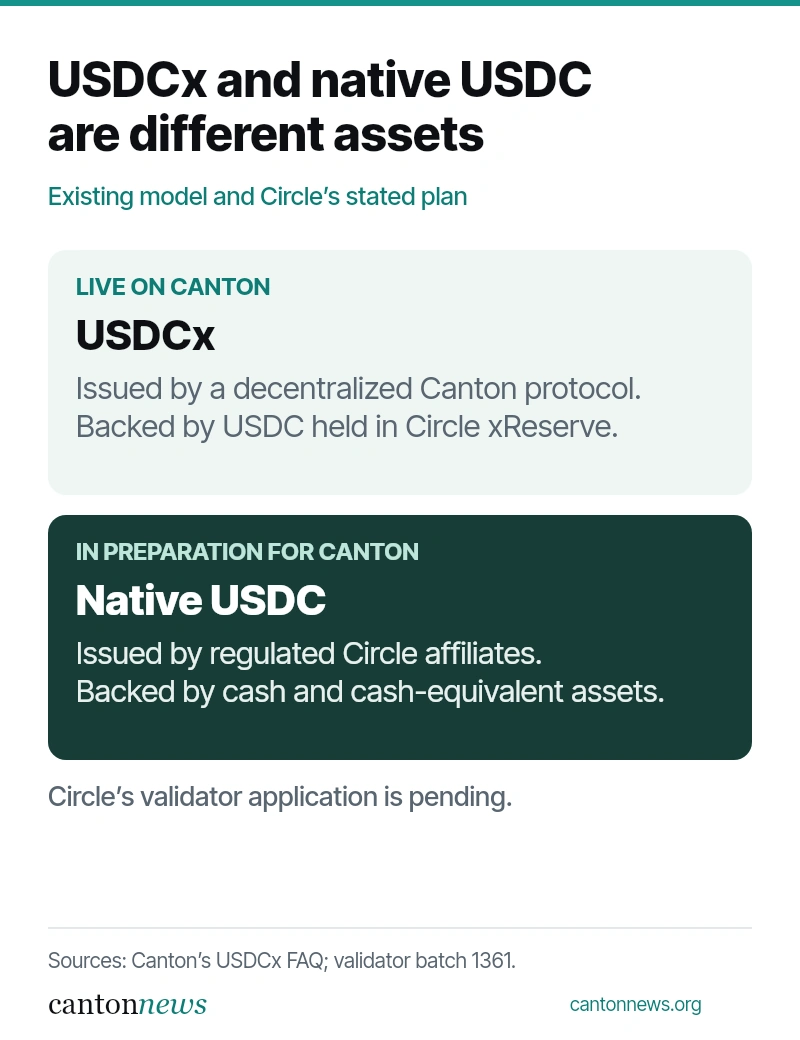 How the existing USDCx model differs from Circle’s planned native USDC. Circle’s validator application is pending. Sources: Canton’s asset FAQ; Circle’s validator application.
This would not be Canton’s first connection to USDC liquidity. xReserve already connects USDC-backed stablecoins with USDC across supported networks. Native issuance would change the asset available on Canton, rather than introduce dollar settlement from scratch.
The distinction is already visible in how users move funds. Cancore opened a route between USDCx on Canton and USDC on Ethereum in August. Users exchange one asset for the other through that route. Circle’s native USDC plan concerns issuing USDC on Canton itself, rather than adding another way to exchange the existing tokens.
Why the distinction matters for users
USDCx already has practical uses. Kraken added Canton deposits and withdrawals in June. Kora later introduced USDCx markets for tokenized gold and silver, alongside trading against Canton Coin.
For a trader, the important question is which asset a venue accepts. A balance in one dollar-denominated token is not automatically a balance in another, even when they can be exchanged one for one. Wallets, exchanges and applications still need to support the asset a customer wants to use.
For a business already using USDC on another network, native issuance would make the Circle-issued asset available on Canton too. If its payment or trading services supported that asset, it could use USDC to settle there rather than hold the separate USDC-backed token.
For customers, the useful next announcements will be about access: which wallets and exchanges support native USDC on Canton, and which applications accept it for payment or trading. Those integrations would turn the issuance plan into something people can use.