
Digital Asset has outlined how covalidation is being adopted by wallets and applications on Canton Network, naming Loop, T-RIZE and Bron among its users.
In a November 19 update, the company describes a model that spreads the hosting and confirmation of a Canton account across independent operators. The aim is to keep services available when a host is disrupted and prevent a single compromised operator from confirming transactions alone.
The practical question is straightforward: if one provider goes offline, can the account keep working?
How covalidation works
On Canton, an account identity is called a party. It can be hosted on one validator or several. Hosting the same party across multiple validators gives each host access to that party’s relevant transaction data and contract state.
The setup includes a confirmation threshold: the number of hosts that must confirm for that party before a transaction can proceed. In a two-of-three arrangement, two hosts must agree. If one becomes unavailable, the remaining two can still meet the threshold.
That also limits what one compromised host can do. With two confirmations required, a single host cannot supply enough approvals by itself.
Canton’s documentation distinguishes hosts that can confirm from observation nodes, which receive data but cannot confirm transactions. Simply adding a read-only replica does not add another confirming operator.
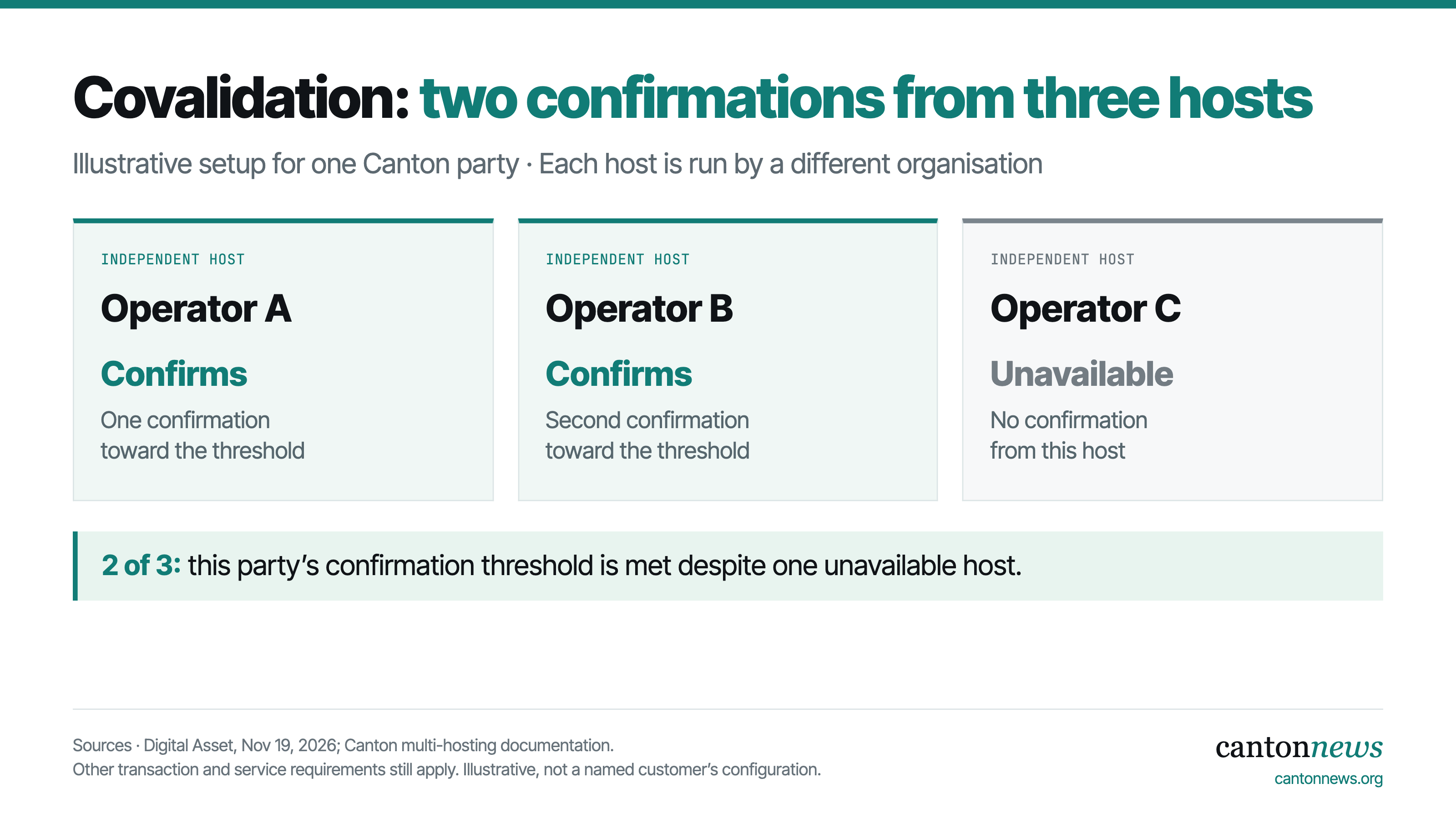 An illustrative two-of-three configuration, based on Digital Asset’s explanation and Canton’s multi-hosting documentation. This is not a diagram of any named customer’s deployment.
The threshold is a design choice. Requiring all three hosts would demand more approvals, but losing one would then prevent that party from meeting its threshold. Operators have to balance the desired protection with availability and latency.
Why independent operators matter
Three nodes run by one organisation can still depend on the same systems, staff or credentials. A breach or outage affecting that organisation could disrupt several hosts together.
DA Covalidation distributes hosting across independent operators selected by the customer. Digital Asset coordinates sourcing, contracts and operations through one vendor relationship. Customers can choose a configuration with or without a Digital Asset-operated node.
The service also covers recovery, operational automation and support. Customers retain control over which providers host their parties, the hosting configuration and their Daml application packages.
Privacy remains part of that choice. Selected hosts need the data required to serve the party. Choosing additional hosts therefore means choosing additional organisations trusted with that information; it does not make the account’s transactions publicly visible to every Canton validator.
Loop, T-RIZE and Bron feature in the update
Digital Asset describes 5N Loop as the first Canton wallet in which every new participant is multi-party hosted. It names Digital Asset and MPCH as independent operators supporting the wallet. The announcement does not disclose Loop’s complete confirmation configuration.
T-RIZE founder and CEO Madani Boukalba says its multi-hosted setup is already live and has strengthened the resilience of its tokenized asset services. Bron founder Dmitry Tokarev also describes an integration intended to strengthen the infrastructure behind its Canton activity.
Digital Asset identifies itself, MPCH and Kiln among the early covalidation service providers. These are examples of adoption and service provision, rather than evidence that every Canton wallet or application uses the same arrangement.
Infrastructure that has been developing since May
The update builds on capabilities delivered earlier this year. Digital Asset’s release notes date the initial public release of its Covalidation Service to May 22, 2026. Subsequent releases have added operational improvements, including monitoring metrics and controls over topology synchronization.
Automation helps keep the required application packages aligned across hosts and reduces the manual work involved in onboarding parties. Those tasks matter because several independent operators must maintain a compatible view of the same account.
Multi-hosting has also appeared in earlier application upgrades. Alpend’s protocol upgrade combined multiparty hosting with separate controls over sensitive administrative actions. Hosting resilience and application governance address different parts of a service’s operation.
Covalidation addresses dependence on a single hosting provider. Its effectiveness still depends on the chosen threshold, the independence and health of the hosts, and the other infrastructure needed to complete a transaction and run the application.