
Palladium Labs has published State of the Canton Network – H1 2026, a 51-page report covering the network’s infrastructure, applications, institutional deployments and token economics.
Produced by the Palladium Labs Research Division, the report presents H1 2026 as a period in which Canton expanded from early institutional pilots into shared-network production across capital markets, payments and open financial markets.
The report maps the organizations participating in the ecosystem, the applications operating on the network and the financial institutions deploying Canton-based services.
Readers can visit the State of the Canton Network – H1 2026 report page or open the complete 51-page report.
Canton Network at a glance
The report provides a detailed snapshot of Canton’s network activity and ecosystem as of June 30, 2026, unless otherwise noted.
The principal figures include:
- More than 490 registered ecosystem participants
- 162,100+ active addresses over 24 hours
- 655+ active validators
- 45+ active Super Validators
- $9T+ in monthly network volume
- $383.56M in fees over 180 days
- $345.07B in real-world asset value
- 38.43 billion CC in circulating supply
- 118 featured applications
- More than 50 Canton Foundation members
The report organizes the ecosystem into 16 categories spanning infrastructure, applications and institutional deployments.
A network designed for institutional finance
Canton is presented as a privacy-aware open network built on Daml. Its Global Synchronizer enables applications to coordinate and settle transactions atomically while allowing participants to retain control over their information.
The report describes a network created to support regulated financial activity across assets, applications and institutional workflows.
Canton Coin is used as the network’s native utility asset. According to the report, Canton Coin had no pre-mine or presale. Coins enter circulation through rewards associated with network activity, while transaction fees remove coins from circulation.
Network governance is supported by the Canton Foundation, with more than 50 members participating in the ecosystem.
Expanding institutional participation
A major development covered by the report is Digital Asset’s $355 million funding round. The round was led by a16z crypto and included participation from BNP Paribas, Citadel Securities, HSBC, Tradeweb and the Abu Dhabi Investment Authority.
Palladium Labs also highlights the growing use of Canton for tokenized financial-market infrastructure.
Broadridge’s Distributed Ledger Repo platform is listed as processing more than $8 trillion in monthly repo volume on Canton. The report also covers DTCC’s work with Digital Asset to support tokenized U.S. Treasury securities held at DTC.
Other developments include institutional tokenization platform T-RIZE adopting Chainlink to support onchain proof of insurance for private-credit assets.
Palladium Labs also launched the Genesis Fund, a 10 million Canton Coin grant program. The fund is intended to support applications, infrastructure, tooling, integrations, research and financial innovation across the Canton ecosystem.
Protocol-fee activity
The report includes a comparison of protocol fees generated across several major blockchain networks.
Using a DeFiLlama snapshot dated July 12, 2026, Canton recorded $57.29 million in fees over 30 days. The figures shown for other networks included $25.84 million for Tron, $13.46 million for Solana, $10.09 million for BSC and $8.19 million for Ethereum.
Canton also recorded $12.9 million over seven days and $1.98 million over 24 hours in the same comparison.
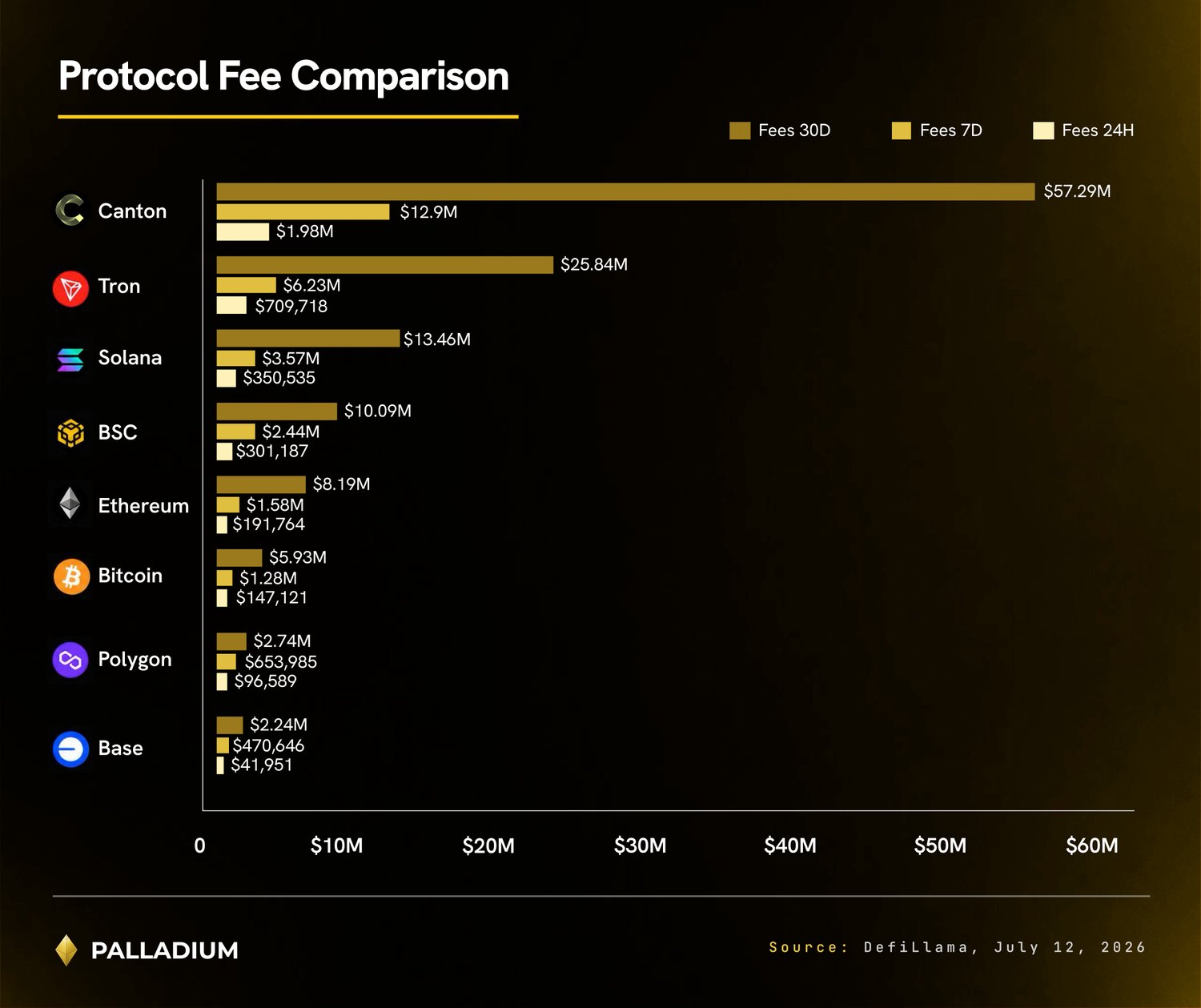
Protocol-fee comparison across major networks. Source: DeFiLlama, July 12, 2026, via Palladium Labs.
Canton Coin’s burn-and-mint model
The report also examines Canton Coin’s burn-and-mint economic model.
New Canton Coin is issued as compensation for productive network activity. At the same time, transaction fees continuously remove coins from circulation through traffic burns.
The report’s chart tracks monthly issuance and burns between July 2025 and June 2026. Following the January 1 halving, monthly issuance settled at approximately 0.65 billion CC, while monthly traffic burns increased to approximately 0.5 billion CC.
The chart shows the mint and burn figures moving closer as network and application activity increased.
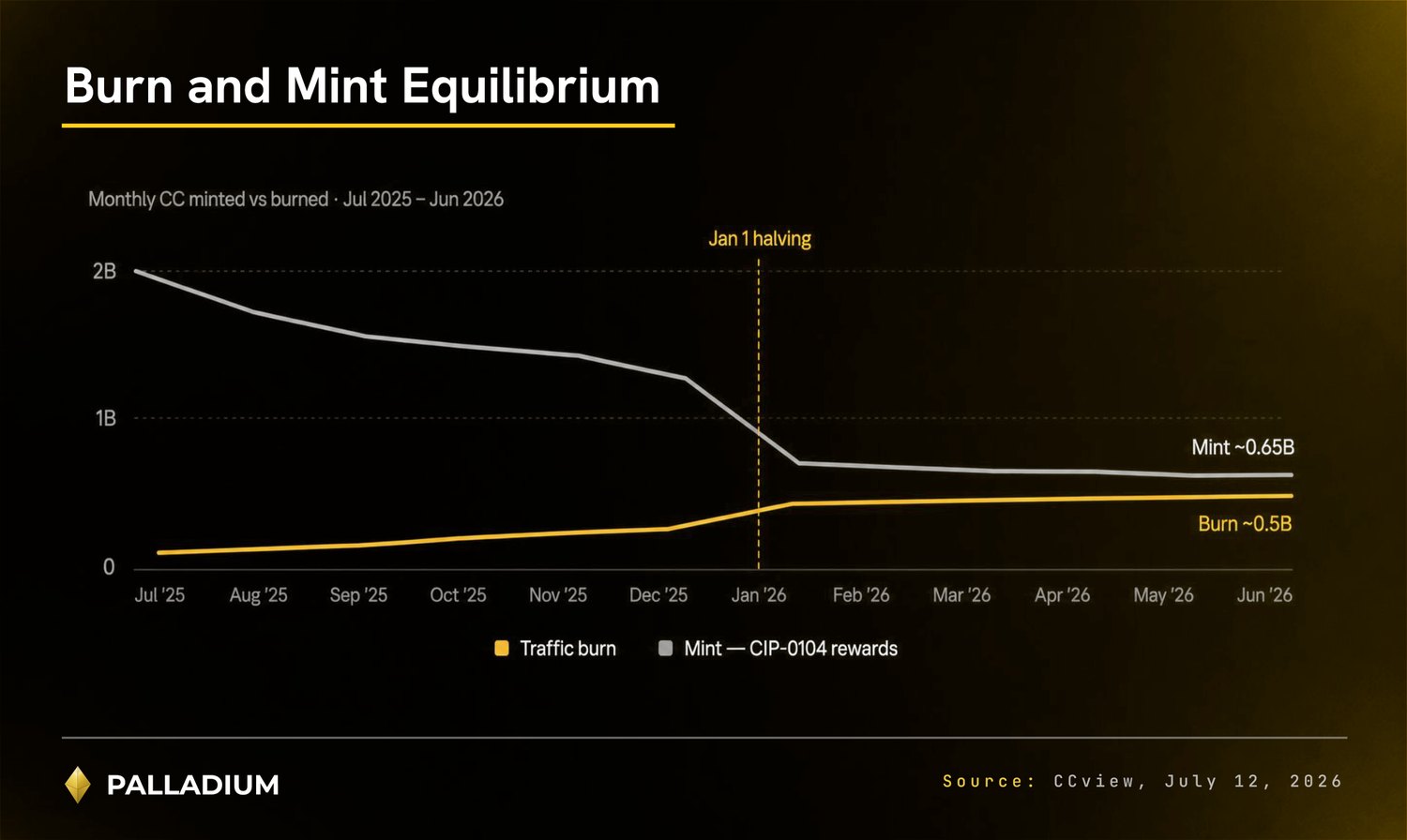
Monthly Canton Coin issuance and traffic burns from July 2025 through June 2026. Source: CCView, July 12, 2026, via Palladium Labs.
A growing application and wallet ecosystem
Palladium Labs identified 118 featured applications across the Canton ecosystem.
The report describes a wallet market serving retail, institutional and self-custody users. Loop Wallet and Send are highlighted as retail-facing products, while Bron, Cantor8, Nightly and Console Wallet support additional institutional and self-custody workflows.
Bron raised a $15 million seed round led by Fasanara Capital. Cantor8 was selected by EDENA Capital as an infrastructure provider for sovereign asset tokenization.
These applications form part of the broader ecosystem mapped in the report, alongside infrastructure providers, exchanges, validators, custodians, tokenization platforms and financial institutions.
Inside the full report
The complete report is organized into eight sections:
- Key Takeaways
- Network Overview
- Key Metrics
- Network Health and Token Economics
- Canton Ecosystem
- Key Milestones in H1 2026
- Outlook for H2 2026
- Closing Synthesis
Together, these sections provide a detailed view of Canton’s network activity, participating organizations, applications, institutional deployments and expected areas of development.
For the complete ecosystem map, supporting data, milestones and H2 2026 outlook, read Palladium Labs’ full State of the Canton Network – H1 2026 report.