
Stratalink’s PoLi Oracle on Canton MainNet. Graphic by CantonNews.
Stratalink Labs is recording signed assessments of digital-asset liquidity on Canton MainNet. A case study shared by IntellectEU on November 17 says its Proof of Liquidity, or PoLi, Oracle has been operating since October 2026, covering BTC, ETH, SOL and Canton Coin across two venues.
The service addresses a different question from whether an asset exists in custody: how much buying and selling interest is available in its market? That matters to an institution assessing whether it could trade without moving the price sharply.
From market orders to a signed record
An order book lists offers to buy and sell an asset at different prices. Stratalink uses live order-book data to calculate liquidity scores independently of the venues being measured. Its Oracle then signs those scores and records them on Canton.
An oracle supplies information from outside a blockchain to applications using it. An attestation is a signed statement about that information. In this case, the statement records Stratalink’s liquidity assessment so authorised parties can verify it on the ledger.
- Read the market: the scoring engine uses live order-book data.
- Calculate and sign: PoLi produces a liquidity score and signs an attestation.
- Record and check: the attestation is recorded on Canton for verification.
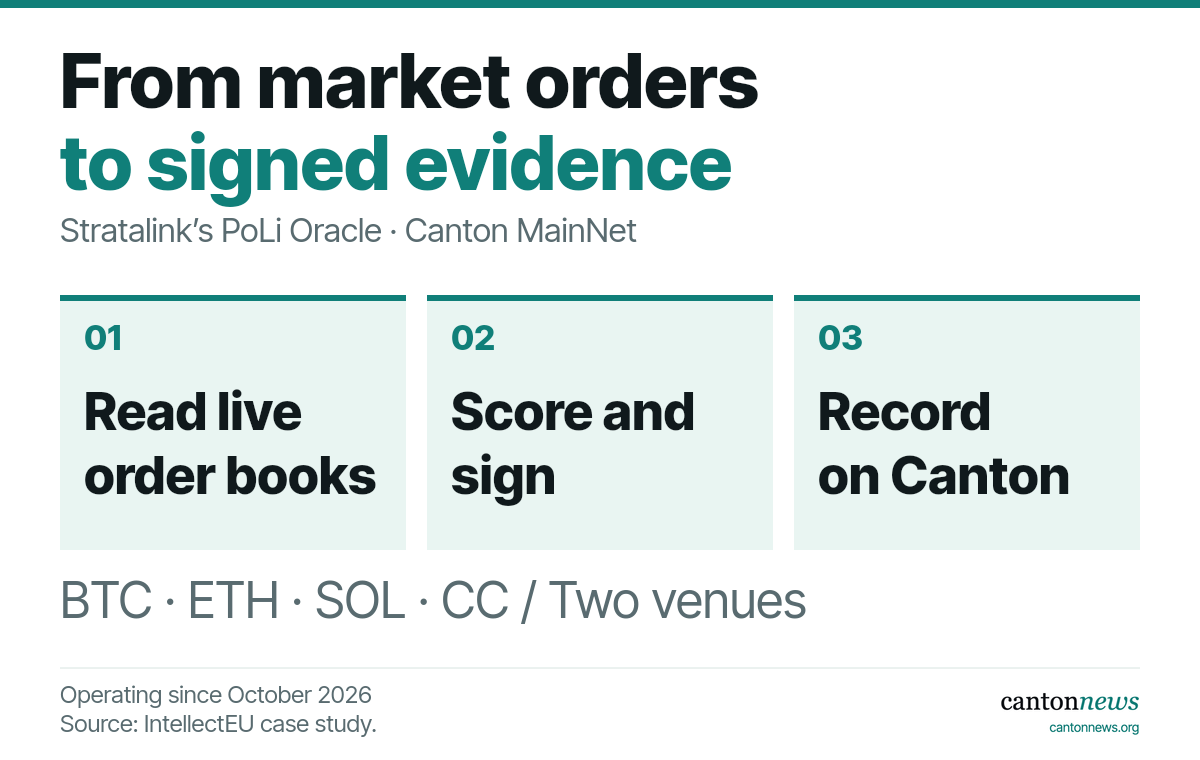
PoLi’s reported workflow. Source: IntellectEU case study.
IntellectEU says each attestation receives an on-ledger compliance check within seconds. The case study does not specify the rules behind that check or provide an independent timing benchmark.
Who provides each part?
Stratalink Labs provides the liquidity scoring engine and PoLi Oracle. IntellectEU built the Daml smart-contract layer connecting the service to Canton. Daml contracts define the shared records and actions used by the application.
CatalyX Blockchain Manager provisions the validator infrastructure hosting the Oracle’s parties. The case study describes monitoring and alerts around the service, with each attestation adding to its MainNet operating history.
What liquidity evidence can tell a user
Proof of Reserves concerns whether assets are held. PoLi concerns the depth of the market behind an asset. A venue could hold a substantial asset balance while having relatively few orders available near the current price. Those are separate things to measure.
A signed score makes the assessment attributable and checkable. It does not guarantee that the same orders will still be available when a later trade reaches the market. The disclosed coverage is also specific: four assets across two venues, rather than a measure of all liquidity on Canton.
Live service, with wider access still ahead
PoLi was among the 13 Development Fund proposals that entered funding votes on October 16. The case study now supplies an account of the production workflow and its initial coverage.
The next phase is to let external consumers request attestations through their own validators. That remains planned in the published account. The November disclosure should therefore be read as a closer look at a service live since October, rather than a new launch date or confirmation that external access is already open.
Sources: IntellectEU’s PoLi case study, CatalyX’s infrastructure account and Stratalink Labs.