
From DTCC to Corporate Treasury: Yuval Rooz Outlines Canton’s Next Phase
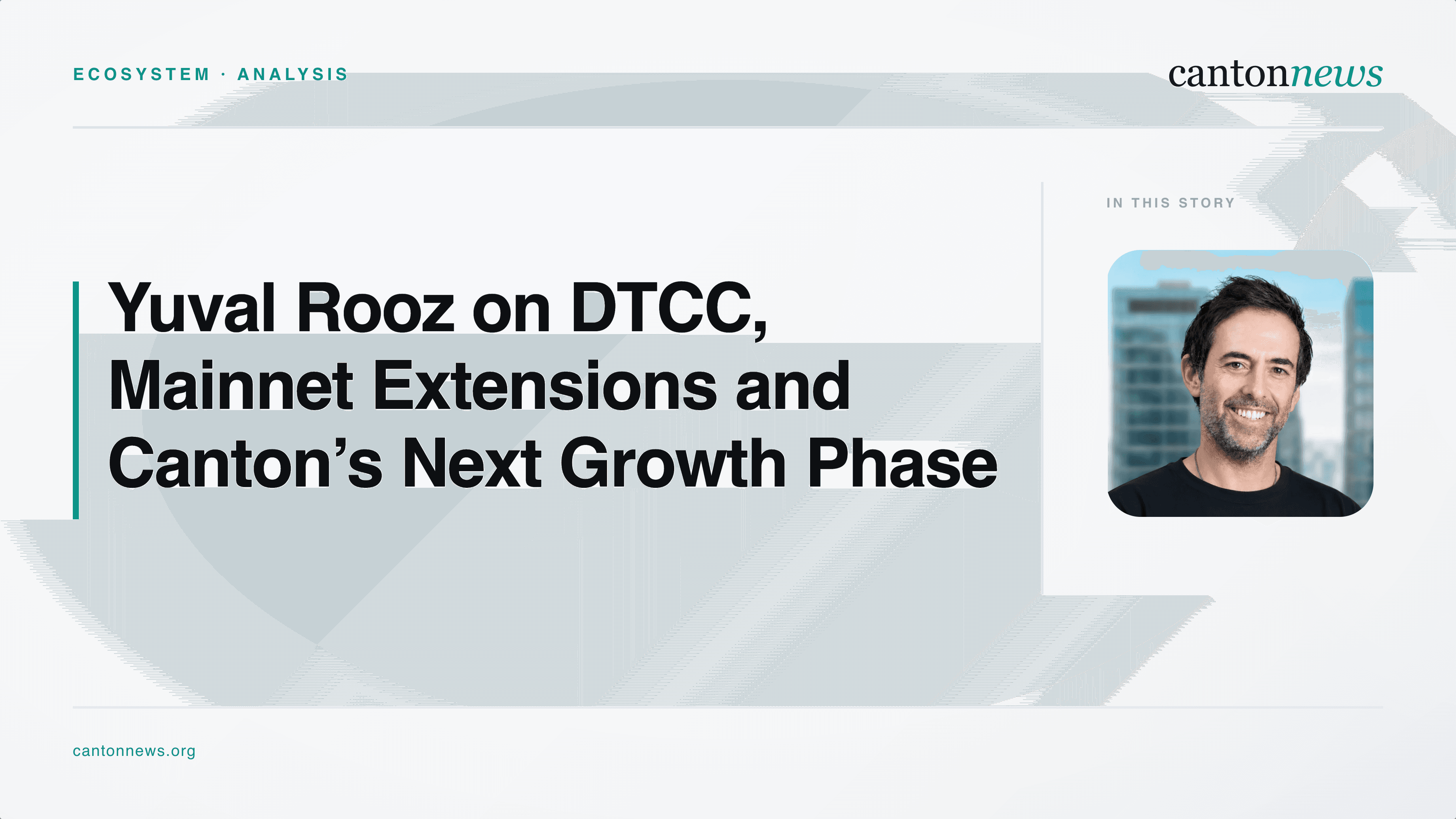
Digital Asset co-founder and CEO Yuval Rooz joined Canton Army for a new edition of Canton Army Alpha Hour, covering how Canton Network has evolved and what comes next.
Rooz discussed Digital Asset’s latest funding round, plans for Canton mainnet extensions, DTCC’s first production activity, corporate treasury management, artificial intelligence and a future retail-focused music project.
Throughout the conversation, he returned to one central theme: building sustainable on-chain activity and increasing Canton Coin burn.
Digital Asset’s funding round brings new partners
Rooz described Digital Asset’s latest funding round as a major success. The round was oversubscribed and led by Andreessen Horowitz, while the discussion also highlighted participation from strategic investors including SoFi, Polychain and Coinbase Ventures.
Beyond the capital itself, Rooz said the round gives Digital Asset a wider group of partners to work with across research, pricing and network adoption.
With the fundraising process complete, the company’s focus remains on bringing more real activity to Canton.
From “subnets” to mainnet extensions
One of the main topics was Digital Asset’s move away from the term “subnet” in favor of mainnet extension.
Rooz explained that Canton is designed as one network. A business may still need its own set of validators or formal service level agreements, particularly when it is running critical enterprise infrastructure, but that environment remains connected to the broader Canton Network.
Calling these environments mainnet extensions better reflects that structure. They may use dedicated infrastructure, but they still form part of Canton and are expected to contribute to the network through Canton Coin burn.
Rooz said mainnet extensions were already operating at the time of the Space, although they were not yet burning Canton Coin. Digital Asset had been working through the pricing and engineering details to make sure the model could support the use cases already running in production.
He said a forthcoming Canton Improvement Proposal would set out the proposed framework.
A fee model built for enterprise activity
The discussion also explored how fees could work for companies that run large parts of their operations on Canton.
Not every ledger update creates the same economic value. Some transactions connect multiple parties, applications or assets. Others are routine internal updates needed to keep a company’s records accurate.
Rooz used a life insurance administration platform as an example. The company may need to update records every day, but those maintenance transactions do not directly generate revenue. Charging the same fee for every internal update could eventually make the platform uneconomical to run on-chain.
Under the model being considered, internal “hygiene” transactions would generate fees until the client reached an annual cap.
Rooz suggested approximately $500,000 per client as an example, although the final amount would be determined through the network’s governance process. Once the cap was reached, qualifying internal updates could continue without further fees.
Composable and value generating transactions would remain uncapped.
Digital Asset is also considering a model that would let large users commit to a certain amount of annual burn in advance.
In return for making that on-chain commitment, a user could receive discounted fees. Any committed volume that was not used would still be burned, creating a use-it-or-lose-it structure.
For institutions, that could provide more predictable costs. For the wider community, it could offer clearer visibility into expected network activity.
DTCC reaches a production milestone
Rooz also discussed the first production activity completed through DTCC’s tokenization initiative.
According to Rooz, the initial transactions were successful and covered a broad mix of use cases, including:
- The conversion of traditional securities into tokenized positions
- ETF-related activity
- Repo transactions
- Securities lending
- The use of tokenized assets as collateral
- Collateral pledges supporting financial obligations
He argued that the opportunity extends well beyond trading tokenized equities.
The post-trade markets surrounding securities including collateral management, repo and securities lending—represent large areas of financial activity in their own right.
Even a relatively small share of those markets could bring meaningful transaction volume to Canton. Rooz said broader availability for DTCC participants was planned for October.
Corporate treasury management could become a major use case
Another major theme was corporate treasury management.
Large companies often keep substantial amounts of cash in different accounts and jurisdictions so they can meet payment obligations at short notice. The trade-off is that much of that cash may sit idle rather than earning a return.
Rooz described how Canton could allow companies to hold tokenized, yield-bearing assets such as money market funds or short-term government securities until a payment is due.
The assets could then be converted into a tokenized deposit or another cash-like instrument in real time, allowing the company to make the payment without keeping the full amount in cash.
For a business holding billions of dollars, even a modest return on previously idle funds could have a significant financial impact.
Digital Asset is working with a treasury management provider that already serves more than 4,000 corporations. The plan is to prove the model with one large company, solve the practical issues around integration, liquidity and banking relationships, and then extend it to more clients.
The initial focus is expected to be on US dollar denominated assets. Expanding the service globally would require additional euro-, yen- and other currency denominated products on Canton.
Digital Asset is still hiring engineers
Rooz was also asked whether AI had changed Digital Asset’s approach to engineering and hiring.
He said the company is still hiring engineers and remains cautious about using AI to develop Canton’s core protocol, where an error could have serious consequences.
Digital Asset does use AI for coding, testing, security reviews and penetration testing.
Rooz said these tools may allow the company to complete more work internally and reduce some of the cost previously spent on external review providers.
For now, the company is using AI selectively while continuing to rely on experienced engineers for critical protocol development.
A retail-focused music project is in development
Although Canton is best known for institutional finance, Rooz revealed that a more retail-oriented project is also being developed.
The project will involve music-related assets and was still several months away at the time of the discussion.
Rooz did not share further details, but said the aim is to bring assets to Canton that could attract broader retail participation.
It offers an early indication of how Canton’s privacy and asset management capabilities could eventually support applications beyond institutional financial markets.
Community feedback and the long-term focus
Toward the end of the Space, Rooz spoke about the value of direct community feedback.
He said he pays attention to suggestions from people who spend time following, researching and contributing to the Canton ecosystem, even when he does not agree with every recommendation.
One recent suggestion was for the Canton Foundation to do more to highlight active projects across the network.
Rooz’s closing message was that Digital Asset remains focused on sustainable activity rather than short-lived speculation.
The goal, he said, is to bring real businesses on-chain and build the kind of usage that can support Canton over the long term.
Listen to the full X Space
The full conversation between Yuval Rooz and Canton Army can be heard here: