
The Depository Trust Company held more than $114 trillion in securities assets as of 2025, according to DTCC. As its tokenization service reaches commercial launch this month, that figure has become the reference point for how large on-chain securities markets could eventually become. The more useful question is what it would look like if even a small slice of it were tokenized.
The question needs a boundary first. The $114 trillion is the size of the custody base, not a forecast of what will be tokenized. The service is voluntary, and DTCC has said it will initially support certain eligible securities, including US Treasuries, securities in the Russell 1000 Index, and ETFs tracking major indices. The service issues tokenized representations of assets that remain held at DTC, rather than moving the underlying securities out of the existing custody system. It also runs across two networks, the private Hyperledger Besu network and the public Canton Network.
With that caveat in place, the arithmetic is simple. The percentages below are illustrations, not projections.
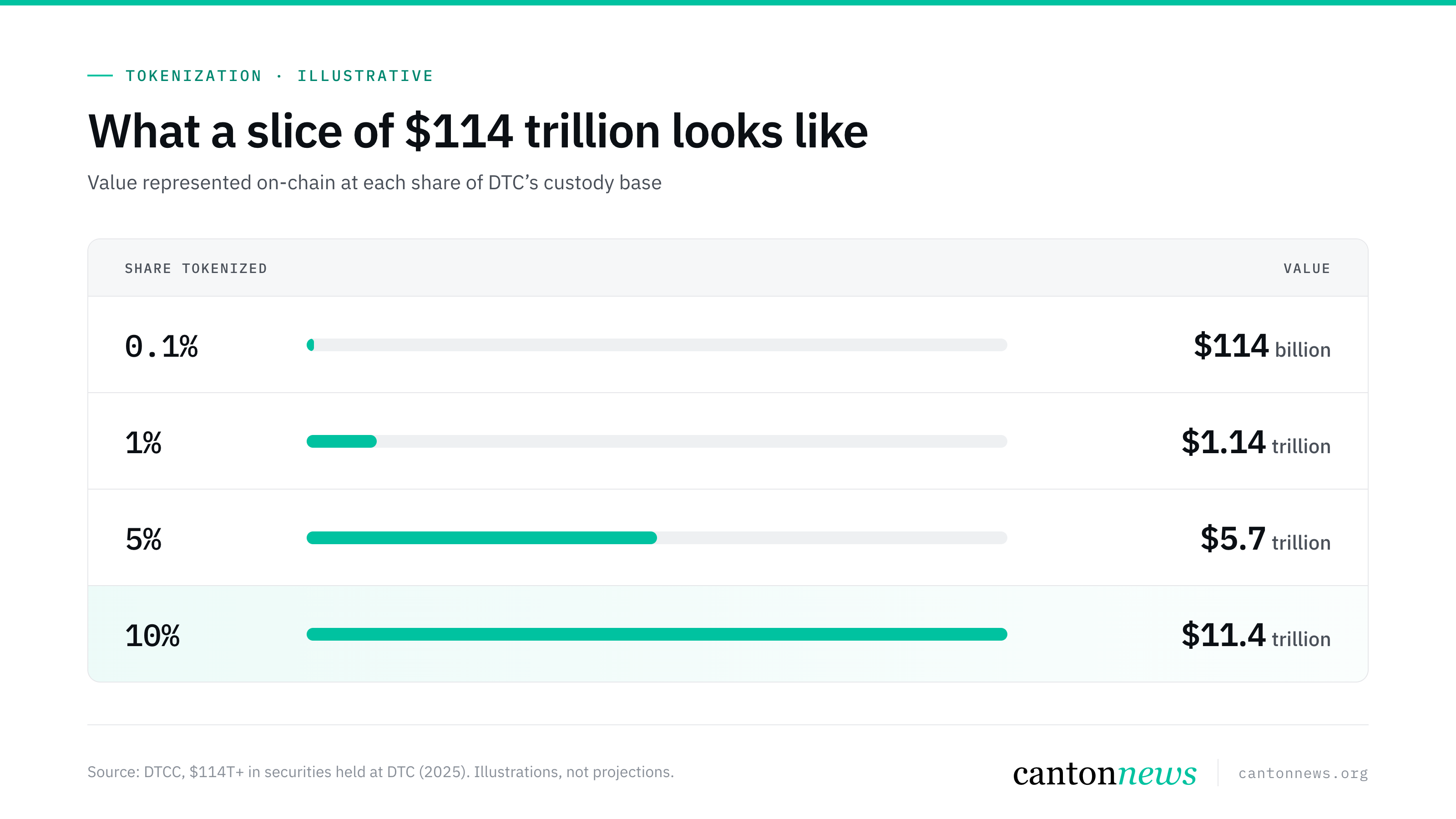
Canton Network has reported more than $9 trillion in monthly transaction volume, a figure that comes from the network itself. The two numbers measure different things. DTC's $114 trillion is a stock of assets held, while Canton's figure is a flow of activity over a month. A tokenized Treasury used as collateral can change hands several times in that period, so even a 1% share, about $1.14 trillion in assets, could generate activity well beyond its face value. The comparison shows the scale involved. It does not show how much will actually arrive.
The more telling number is not the custody total but how little of the world's safest collateral is actually put to work. DTCC estimates there is about $300 trillion in global High Quality Liquid Assets, of which only 10 to 11 percent is currently used as collateral, or roughly $30 trillion to $33 trillion. The argument for tokenization rests on that gap. Digital Asset, the company that developed Canton, estimates that tokenized workflows could raise balance sheet efficiency by 30 to 50 percent by letting collateral move in real time instead of sitting in settlement cycles.
The July 15 production event showed what that movement looks like in practice. More than 30 firms ran collateral pledge, securities lending, Treasury and repo delivery-versus-payment, equity settlement, and central counterparty margin workflows. In one documented example, Citadel Securities created a tokenized representation of US Treasuries on Canton, transferred it to counterparties including BNP Paribas and Société Générale, and posted it to CME as collateral, according to Fireblocks. That was one participant and one chain of transfers, and it shows the use case the numbers above are meant to scale.
There is a limit on how directly these figures translate into Canton's economics. The network burns all fees it collects, and Canton generated $50.2 million in fees in the 30 days to September 12, according to DeFiLlama data. But fees are driven largely by traffic purchases rather than by the notional value of what is being settled. A trillion dollars of securities can settle in a modest number of transactions. What drives burn is activity, meaning transactions, participants, and the infrastructure supporting them, not the headline value moving through the system.
That makes the October launch a test of adoption rather than of size. The relevant questions are how many of the more than 100 firms in DTCC's industry working group move from testing to routine use, how much of the eligible universe is actually tokenized, and how much of that activity runs on Canton rather than on Besu. DTCC and Digital Asset have outlined a path, but the volumes that follow will decide whether $114 trillion remains a ceiling or becomes a pipeline.