
How Canton’s Universal Burn proposal aims to bring dedicated synchronizers into the same economic framework as the Global Synchronizer.
Canton MainNet is already an interconnected network, but its synchronizers have historically operated under different economic arrangements.
Traffic on the Global Synchronizer is paid for by burning Canton Coin (CC), while eligible applications and validators receive network rewards. Dedicated synchronizers, on the other hand, have historically operated under commercial software arrangements in which fees were paid to Digital Asset, outside the network’s burn-and-reward economy.
CIP-0129, titled Universal Burn and Synchronizer Pricing, seeks to address this difference. Approved on 23 October 2026, the proposal introduces a framework in which every synchronizer running production workloads on Canton MainNet contributes to the same CC-based economic system.
The objective is not to merge every synchronizer into one infrastructure layer. It is to establish a shared economic model while allowing dedicated synchronizers to retain their operational independence.
The Economic Question Behind Canton’s Architecture
Canton supports multiple synchronizers. Most network participants use the Global Synchronizer, operated by the Super Validators, while others operate dedicated synchronizers for specific applications and workloads.
These synchronizers are part of the same MainNet. They can support the same assets and enable applications across different synchronizers to interact.
However, their economic arrangements have been different.
The Global Synchronizer already operates within a CC-funded traffic model. Dedicated synchronizers have historically relied on commercial software licence fees instead.
This creates an economic separation within an otherwise interconnected network.
The question behind CIP-0129 is straightforward: should production activity contribute to the same network economy regardless of which synchronizer processes it?
The proposal's answer is yes. Every production synchronizer should contribute through traffic payments, while eligible applications and validators should be able to earn rewards under the same network rules.
Understanding Canton’s Existing Synchronizer Economy
To understand what changes, it is important to understand how the current model works.
On the Global Synchronizer, network traffic is priced according to the amount of data processed. The current list price is $60 per megabyte, equivalent to approximately $1 for a typical transaction before rewards.
The corresponding payment is made in Canton Coin and burned. Applications and validators can then receive CC rewards for eligible activity under the network's existing reward rules.
Dedicated synchronizers have historically followed a different arrangement. Their operators paid commercial software licence fees to Digital Asset, and their traffic did not participate in the same burn-and-reward mechanism.
CIP-0129 proposes replacing this economic separation with a common framework.
Importantly, the proposal does not change the existing reward allocation between Super Validators, validators, applications and the Development Fund. It also does not change CC issuance or the Global Synchronizer's existing list price.
What CIP-0129 Proposes
At its core, CIP-0129 introduces three major changes.
Universal traffic burn
Every synchronizer running production workloads on Canton MainNet would pay for its traffic by burning CC. This includes the Global Synchronizer and dedicated synchronizers.
Shared reward eligibility
Eligible applications and validators would earn rewards for activity regardless of which synchronizer processes their traffic. The same network reward rules would apply.
Volume-based pricing for dedicated synchronizers
Dedicated synchronizers would receive a pricing model that reduces the price per unit of traffic as sustained throughput increases. Additional discounts would be available to operators who make longer-term throughput commitments backed by CC collateral.
These changes are intended to make dedicated infrastructure economically compatible with the wider network without requiring every workload to move onto the Global Synchronizer.
The framework is described in the approved CIP-0129 proposal.
How Universal Burn Works
The proposal involves several connected mechanisms. Registration, traffic payments, usage reconciliation and reward reporting each serve a different purpose.
Registration Comes First
Before a dedicated synchronizer can participate in the traffic-payment framework, it must be registered so the network can recognise it for payment accounting and reporting.
The initial implementation plan expects registration to happen through a Super Validator vote. Permissionless self-registration is intended for a later phase.
This distinction matters: operating a dedicated synchronizer is permissionless. Registration is not a licence to operate; it connects the synchronizer to the proposed economic framework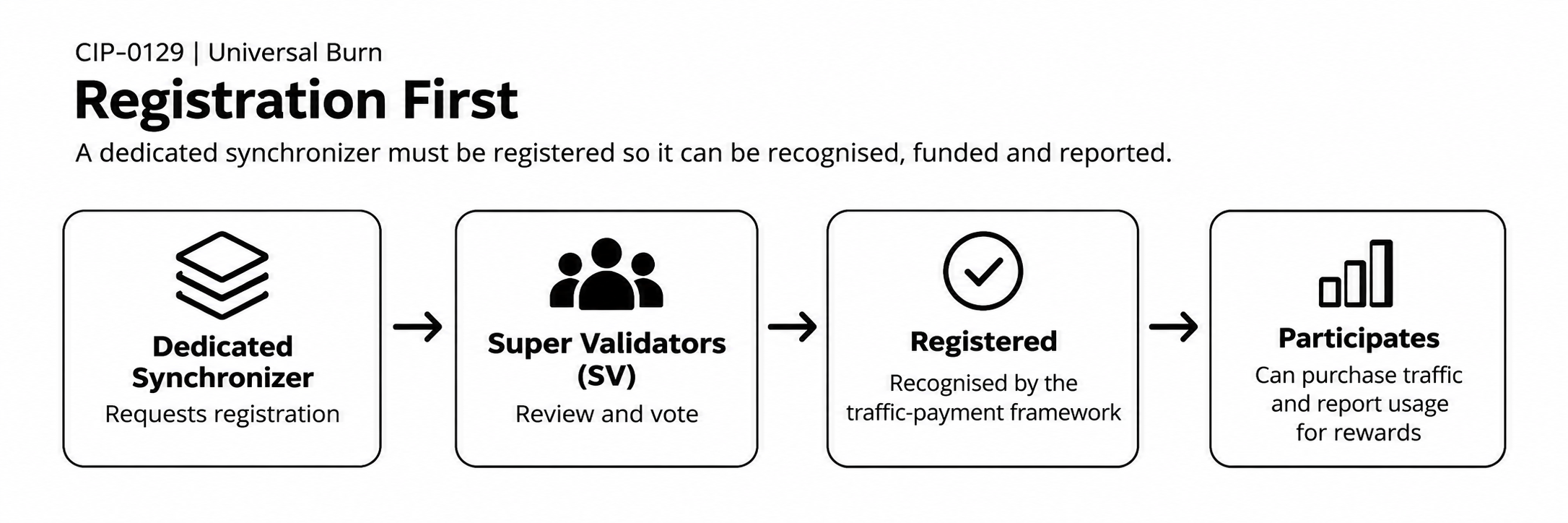
The Paymaster Coordinates Traffic Payments
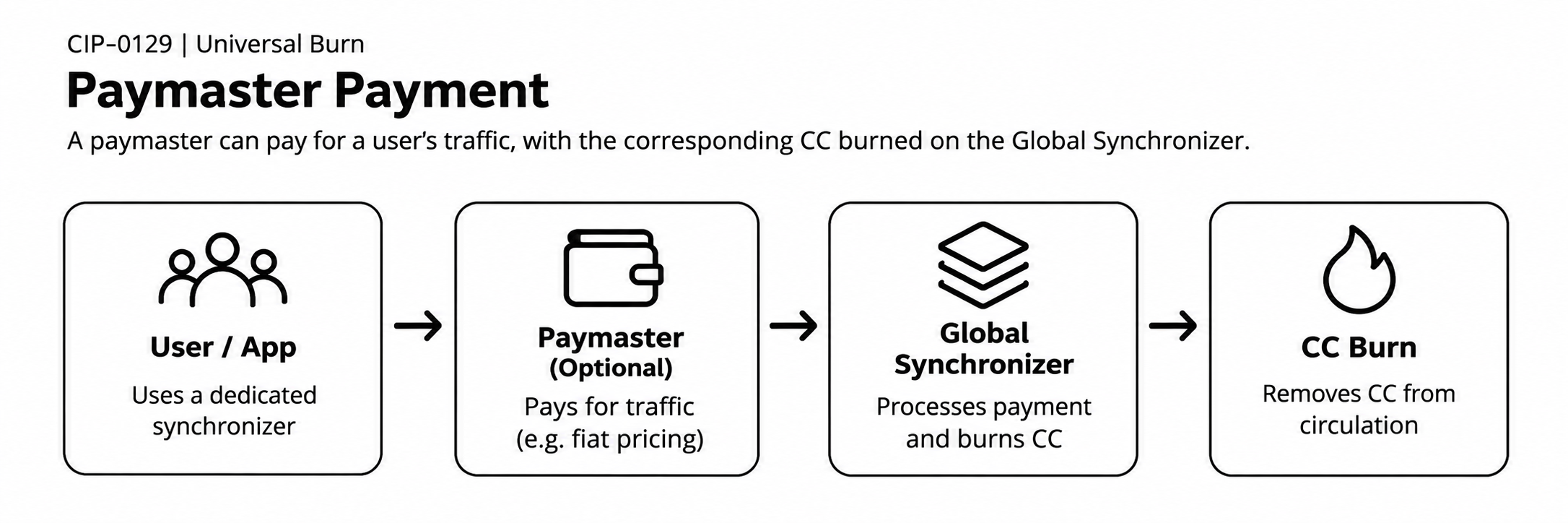
Traffic payments are processed through the Global Synchronizer.
A user or application can pay for traffic directly, while a paymaster can optionally cover the payment on the user's behalf. Paymasters can also offer users a fixed fiat-denominated price, even though the underlying network payment is made in CC.
The Global Synchronizer processes the traffic purchase and burns the corresponding CC.
One important distinction is that CC does not move onto the dedicated synchronizer. The traffic purchase and burn take place through the Global Synchronizer.
Traffic Consumption Is Reconciled
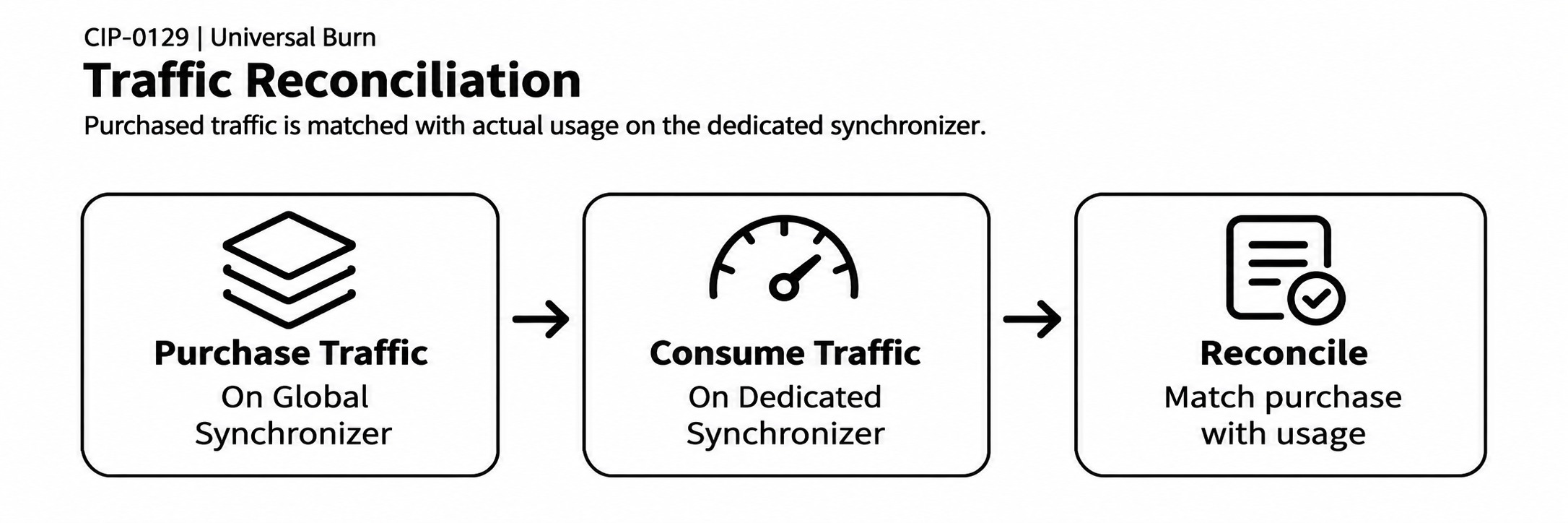
Purchasing traffic and consuming traffic are separate activities.
The traffic allowance funded through the Global Synchronizer must correspond to the actual usage taking place on the dedicated synchronizer.
The operator makes the purchased allowance available and monitors consumption. Reconciliation then compares the traffic that was funded with the traffic that was actually used.
This provides an accounting connection between the payment made on the Global Synchronizer and the activity taking place on dedicated infrastructure.
Usage Reporting Connects Activity to Rewards
The reward mechanism introduces another requirement: activity must be attributed to the applications and validators eligible to receive rewards.
Because Super Validators cannot directly observe transaction-level activity on dedicated synchronizers they do not operate, the dedicated synchronizer operator must publish aggregate usage reports through the Global Synchronizer.
These reports attribute activity to individual parties according to the network's reward rules.
There is, however, a trust assumption. At launch, reporting relies on the operator being honest. A dishonest report could misdirect rewards between participants on that synchronizer, although it cannot claim rewards on more traffic than the synchronizer or its users actually paid for. The proposal leaves room for stronger enforcement mechanisms through future work.
The intended framework extends reward eligibility to dedicated-synchronizer activity, but the implementation plan places full dedicated-synchronizer reward distribution in a later development phase. Approval should therefore not be confused with a fully deployed reward pipeline.
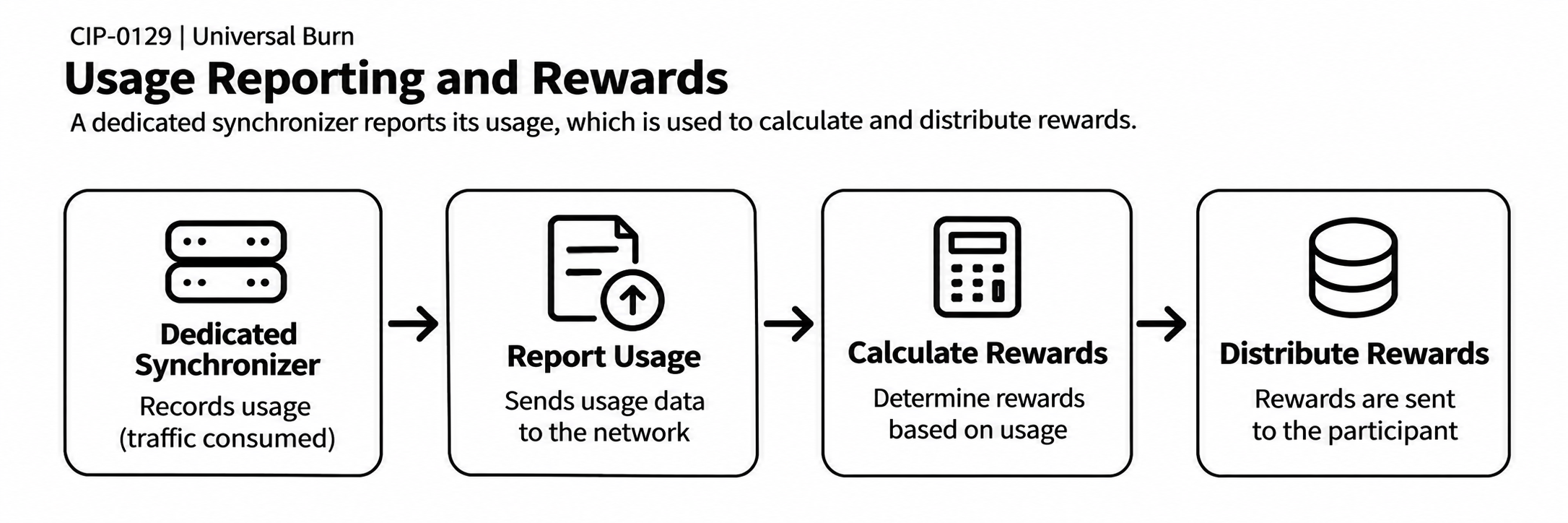
Graphic note: The diagram illustrates the intended reward pathway. Full reward distribution for dedicated-synchronizer activity remains part of later implementation work.
The Economics of One Network
One of the most important parts of CIP-0129 is its proposed pricing model.
A single flat price can make high-throughput, low-value transactions expensive. This is particularly relevant to payments and trading applications, where transaction volume can be high while the value of each individual transaction may be relatively small.
To address this, the proposal introduces volume-based pricing for dedicated synchronizers.
Under the proposed model, the price per unit of traffic decreases as sustained throughput increases. The Global Synchronizer retains its single list price; the volume-based curve applies to dedicated synchronizers.
The supporting materials illustrate the proposed pricing using the following examples:
Sustained throughput Illustrative price per typical transaction
1 TPS $1.00
10 TPS $0.50
100 TPS $0.25
1,000 TPS $0.125
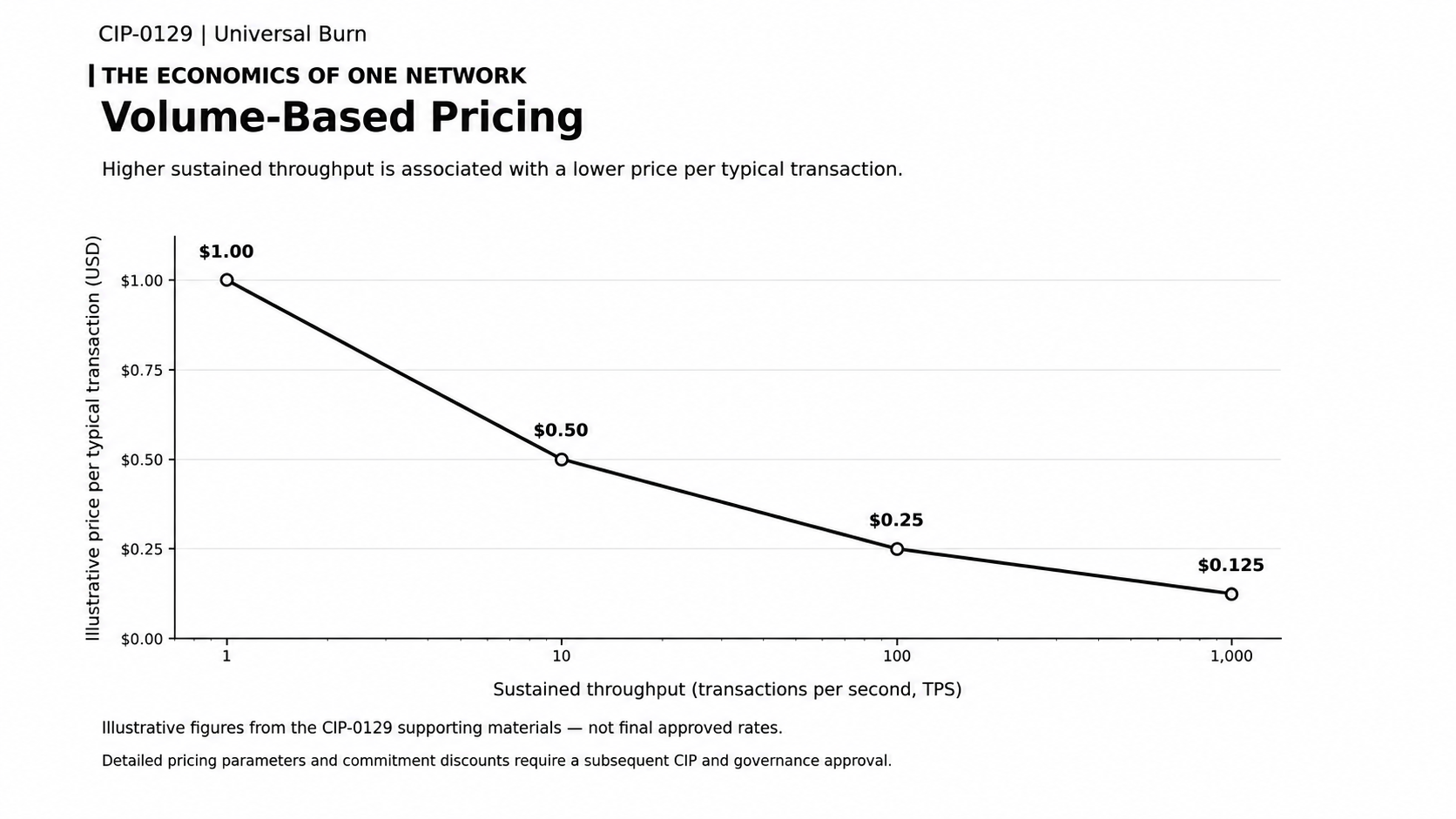
These figures are illustrative, not final approved rates. The detailed pricing curve, measurement rules and discount parameters require a subsequent CIP and further Super Validator governance approval.
The proposal also introduces optional commitment discounts. Dedicated synchronizer operators could commit to a level of throughput for a year or longer and back that commitment with CC collateral.
Three discount components are proposed:
- Commitment discount: for committing to a throughput level.
- Collateral discount: for providing additional CC collateral.
- Loyalty discount: for maintaining the commitment and collateral over time.
The aim is to make high-volume usage more economical while giving the network greater visibility into expected future traffic.
However, lower unit prices do not automatically mean higher total CC burn. The overall impact depends on whether cheaper traffic attracts enough additional production activity to offset the reduction in price per transaction.
What the Numbers Reveal
The existing relationship between network burn and scheduled issuance provides useful context for understanding the proposed changes.
According to the CCTools network data snapshot of 9 November 2026, the network recorded the following figures:
Period CCburned Scheduledissuance Burn as a share of issuance
7 days (2–8 November) 107.5M 186.6M 57.6%
30 days (10 October–8 November)439.3M 798.9M 55.0%
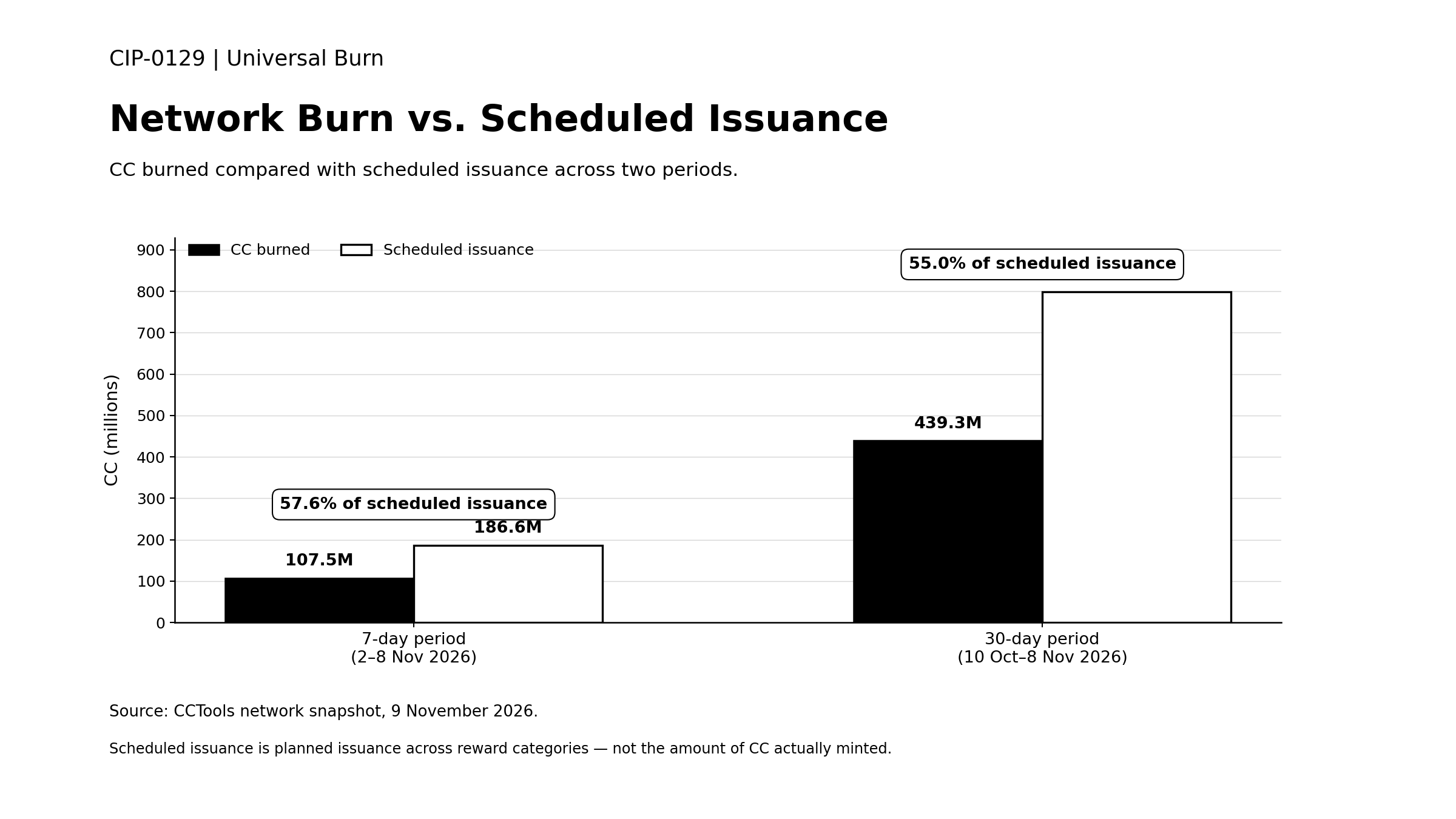
These figures show that CC burned over the two periods represented 57.6% and 55.0% of scheduled issuance respectively.
There is an important distinction here: scheduled issuance is not the same as CC actually minted. The issuance figure represents the amount scheduled across the network's reward categories. Some unclaimed rewards are not minted, while other rewards are minted only when claimed.
The comparison therefore provides context for the relationship between burn and planned issuance, rather than proof that the network's circulating supply is declining.
CIP-0129 does not change the network's issuance schedule. Its proposed contribution is to extend CC-funded traffic payments to dedicated synchronizers, bringing more production activity into the existing burn mechanism.
The figures can be checked against the CCTools network data.
From Approved Proposal to Implementation
Approval of CIP-0129 establishes the economic framework, but it does not mean that every component is already live.
The proposal outlines two estimated implementation phases.
Phase 1: Estimated Q1 2027
The first phase is expected to introduce Universal Burn. Dedicated synchronizers would begin participating in CC-funded traffic payments, with interim discounts available through case-by-case Super Validator approval.
Phase 2: Estimated Q3 2027
The second phase is expected to introduce the volume-based pricing curve and commitment discounts, following approval of a subsequent CIP containing the detailed parameters.
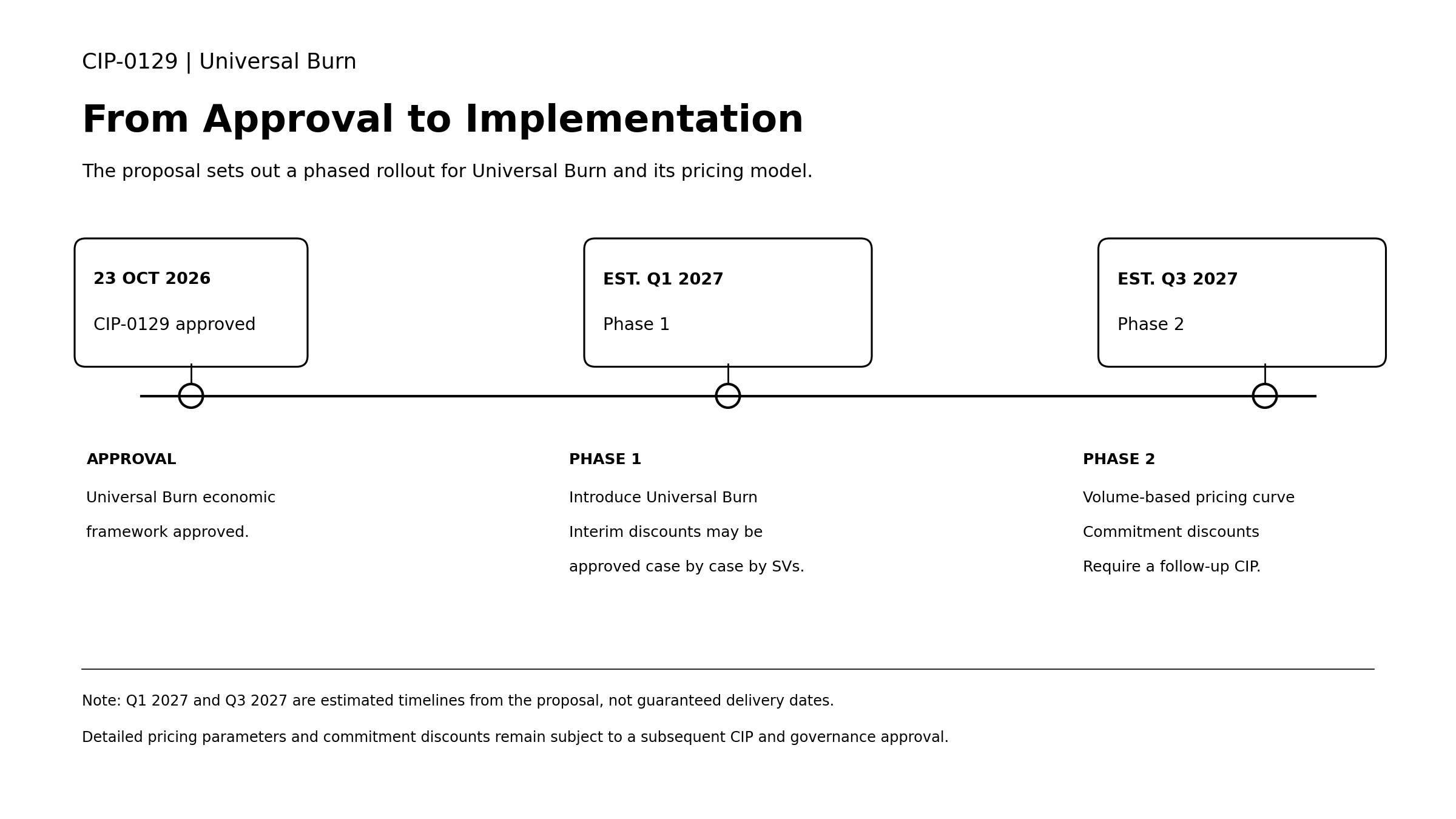
The authors describe these as ambitious estimates, not guaranteed delivery deadlines.
The engineering plan also separates the initial traffic-payment infrastructure from the later reward-distribution work. Its Phase 2 scope includes registration, CC-funded traffic purchases, governance discounts, operator tooling and reconciliation. Full application-reward distribution for dedicated-synchronizer activity is placed in Phase 3.
This distinction is important. The approved framework establishes the direction, while implementation is being developed in stages.
The development plans are available in the Phase 2 implementation plan and Phase 3 implementation plan.
The Challenges Ahead
CIP-0129 creates an opportunity to bring more production activity into Canton's shared economic framework, but several questions remain.
First, usage reporting introduces a trust requirement. Operators must provide accurate aggregate reports so eligible activity can be attributed correctly. Stronger verification may become necessary as the framework grows.
Second, the pricing parameters still need to be established. Volume thresholds, collateral requirements, commitment rules and discount levels will determine whether the model is attractive to high-throughput operators.
Third, lower transaction costs must translate into real adoption. A cheaper price per transaction is useful only if it encourages additional production workloads that contribute meaningfully to network activity.
Finally, implementation must deliver on both sides of the economic model: traffic payments and the reward distribution that makes eligible applications and validators part of the same system.
These are not reasons to dismiss the proposal. They are the practical questions that will determine how successfully the framework works beyond its approval.
What One Network, One Economy Could Mean for Canton
CIP-0129 is not a proposal to eliminate dedicated synchronizers or force every application onto the Global Synchronizer.
It is an attempt to align the economics of infrastructure that already belongs to the same interconnected network.
Dedicated synchronizers can retain their operational independence while production traffic contributes through the same CC-funded payment framework. Eligible applications and validators can participate in the same reward rules, while volume pricing and commitment discounts aim to support larger workloads.
The central idea is simple: different synchronizers can serve different purposes without operating under fundamentally separate economic systems.
Whether Universal Burn achieves that objective will depend on the quality of its implementation, the final pricing parameters, the reliability of usage reporting and the amount of real production activity it attracts.
CIP-0129 establishes the direction. The next phases will determine how effectively Canton can turn that direction into one shared network economy.