
CatalyX Blockchain Manager 2.0. Source.
CatalyX is bringing more of the work around a Canton validator into one place. Its November 4 overview of Blockchain Manager 2.0 explains how teams can manage the node, connect custody providers, control signing keys and deploy applications through the same platform.
A validator is the node through which an organisation uses Canton. Keeping that node running is only part of the job. Teams also need to decide who holds the keys, which applications can connect and how users keep working if a host becomes unavailable.
What the platform brings together
- Setup: define a validator once and let the platform configure the services around it.
- Key management: keep signing keys in a service controlled by the customer.
- Custody: connect applications while a chosen provider handles signing.
- Applications: configure and deploy supported services through a marketplace.
Less work between the node and the application
CatalyX is developed by IntellectEU, which says it uses Blockchain Manager behind more than 100 production validators. The new generation replaces the 1.x software with a rebuilt web console and API, the interface other software uses to automate tasks.
Instead of setting up every component separately, an operator describes one validator. The platform then provisions the participant node, validator app, wallet and identity services and reports each component’s status. Administrators can also run Canton commands in the browser without opening a separate connection to the underlying cluster.
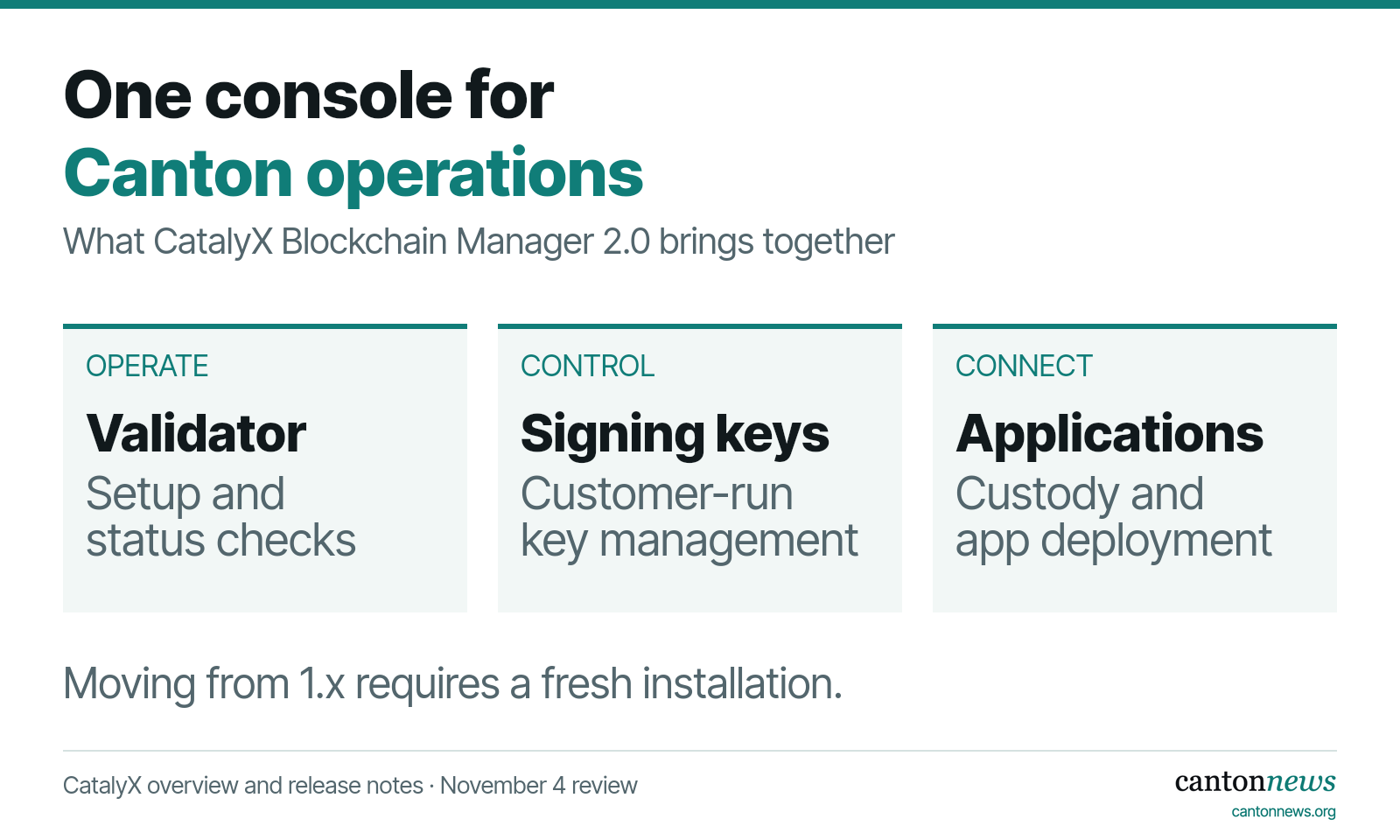
The operating model described in CatalyX’s 2.0 overview.
Keeping control of the keys
A key management service, or KMS, stores and controls the keys used to sign. Version 2.0 supports hardened setups for Azure and AWS, including hardware-backed keys, audit logging and checks that reject weak configurations.
The optional Wallet Gateway connects compatible Canton applications to the validator. Signing stays with the configured signing or custody provider. The release notes describe support for DFNS and BitGo, with more than one provider able to be active.
One user identity, more than one host
On Canton, a party is an identity that can hold rights and take part in transactions. It is different from the machine hosting it. CatalyX supports hosting a party on several participants, including participants run by different organisations.
That gives institutions a way to reduce dependence on a single host. In a suitable multi-host setup, the party can keep working through another participant if one validator becomes unavailable. It is a configuration to build and operate, rather than a promise that every deployment is automatically resilient.
Trying it and adding applications
Sandbox mode lets a signed-in user create a DevNet validator by entering a name. DevNet is a development environment for trying software, not Canton’s production network. Teams move to TestNet and MainNet through a regular installation.
The CatalyX Marketplace provides a place to configure and deploy applications. The overview names CatalyX Package Manager and Daml Coding Assistant among its first listings. For builders, the aim is to make adding a service less dependent on manually assembling its deployment.
What existing customers need to know
This is a new overview of an existing release line, not a claim that every feature arrived on November 4. The release notes date version 2.0.2 to October 16. Moving from 1.x requires a fresh installation, with IntellectEU’s support team helping customers plan the migration.
The broader direction builds on CatalyX’s earlier work with Noves on access to private Canton data: giving operators the tools around the node as well as the node itself.
Official links
Sources: November 4 overview · Release notes.