
Four Development Fund approvals on November 4. Source.
Four Canton Development Fund proposals gained approval on November 4, covering how users add hosting providers, how validators buy network capacity, who can cast governance votes and how developers investigate problems.
The work is largely behind the scenes, but each project addresses a practical obstacle to running applications on Canton. The approvals fund development and adoption milestones. They do not mean the new capabilities are all available today.
The four projects at a glance
- Online party replication: 18 million CC base funding for Digital Asset, with up to 20.7 million CC including an adoption bonus.
- Finoa traffic purchase app: 2.995 million CC.
- Super Validator governance app: 1 million CC for Digital Asset.
- Daml Shell: 5.28 million CC base funding for an open-source transition, with a conditional early-delivery bonus.
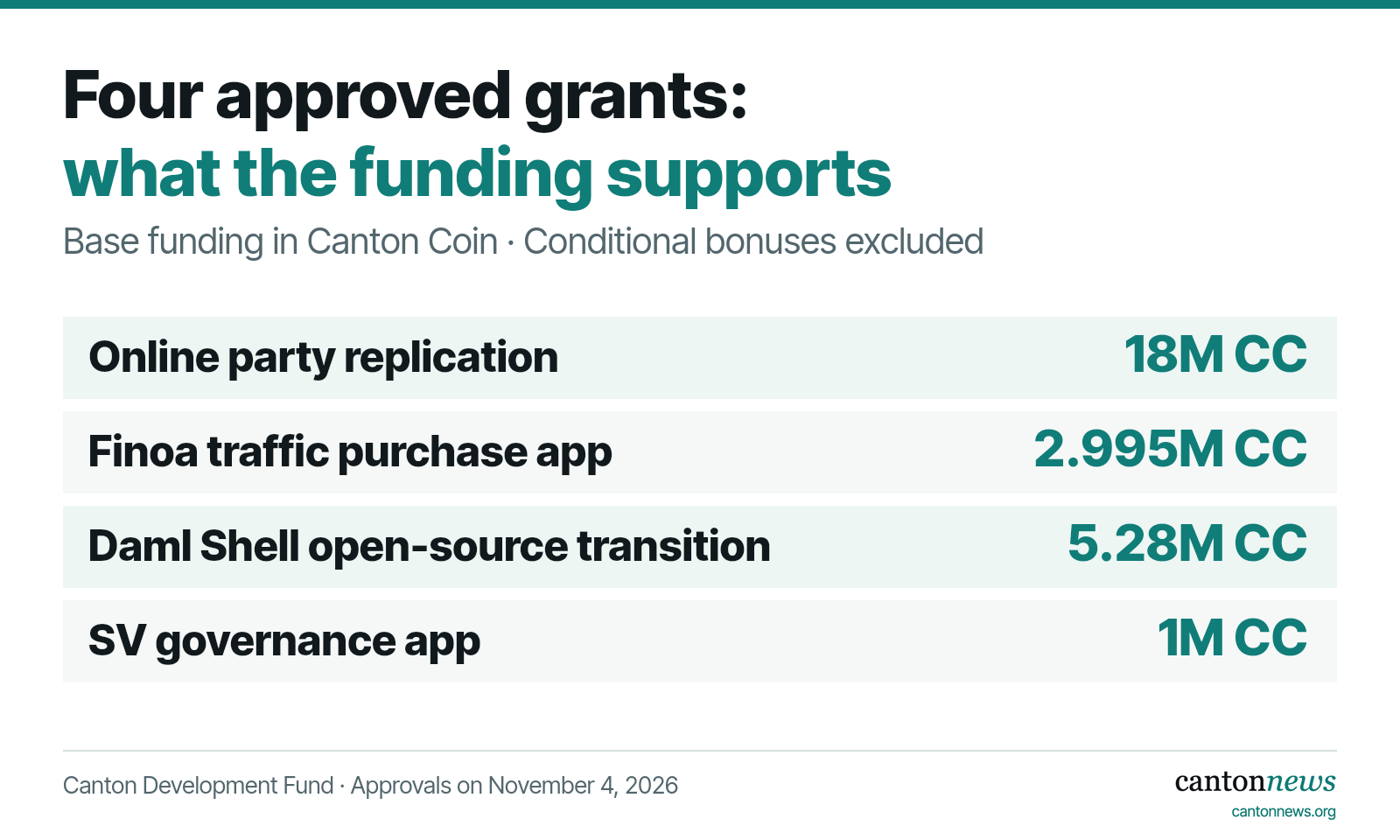
Base funding, excluding conditional bonuses. Replication · Finoa · Governance · Daml Shell.
Adding a new host without stopping activity
The largest award supports Digital Asset’s online party replication project. A party is a Canton identity with rights to take part in transactions. A validator hosts that identity and the contract data it needs.
Today’s offline replication process involves exporting and importing data and pausing the target node’s transactions. The project aims to let a party add a new hosting node while continuing to transact. That could make it easier for wallet providers and operators to add redundancy or distribute users across hosts.
An illustrative case is a wallet provider adding a second host for a customer’s Canton identity. Online replication would copy the active contract information needed by the additional host. It would not, by itself, remove the original host: offboarding and broader migration are reserved for a later phase.
The proposed delivery spans 16 months, moving through intermediate replication tools, testing and MainNet availability. Production rollout also depends on network protocol adoption and operators enabling the required communication channels. The final capability remains development work.
A simpler way to top up a validator
Finoa Consensus Services’ traffic purchase app addresses a more immediate operating task. Traffic is the network capacity a validator needs to process activity. An operator needs a way to buy more when that balance runs low, including when the validator can no longer transact on its own.
The planned open-source app lets someone connect a supported wallet, sign a purchase and fund a validator’s traffic balance. It also includes a route through a licensed provider for users who first need to buy CC with ordinary money. The app itself would not hold users’ money or CC.
The 2.995 million CC grant covers development and six months of maintenance after the first release. An external audit is outside this award and could be the subject of a separate request.
Letting the right person cast the vote
Digital Asset’s governance app would let a Super Validator operator delegate voting to another authorised party. Super Validators help operate and govern Canton’s Global Synchronizer, the shared service that coordinates transactions across the public network.
This separates the job of running a node from the job of making governance decisions. The delegate would use a compatible wallet and voting interface. The proposal keeps one vote per Super Validator node; it does not create extra votes or redesign voting rights.
The 1 million CC project continues work from an earlier grant and sets out a roughly 22-week delivery plan. A Canton Improvement Proposal, or CIP, still needs to be accepted for the relevant changes to be adopted.
Making an existing investigation tool open source
Daml Shell helps developers and support teams inspect local ledger information. For example, they can investigate an archived contract or trace why a workflow stopped, without writing database queries by hand.
The tool already exists and is used by ecosystem teams. This grant funds preparation for an Apache 2.0 open-source release and wider adoption, rather than building it from scratch. The base award is 5.28 million CC over about eight months, with a conditional bonus for early delivery of the adoption milestone.
What happens after approval
Some of these projects appeared in the earlier round of Development Fund votes. November 4 brings a change in status: the four proposals are labelled Approved and their pull requests have been merged.
The next evidence will come from the work itself: delivered software, tests, operator use and committee acceptance of the agreed milestones. Grant approval authorises the project; payment and a production release are later steps.
Sources: Party replication · Traffic purchase app · Governance app · Daml Shell.