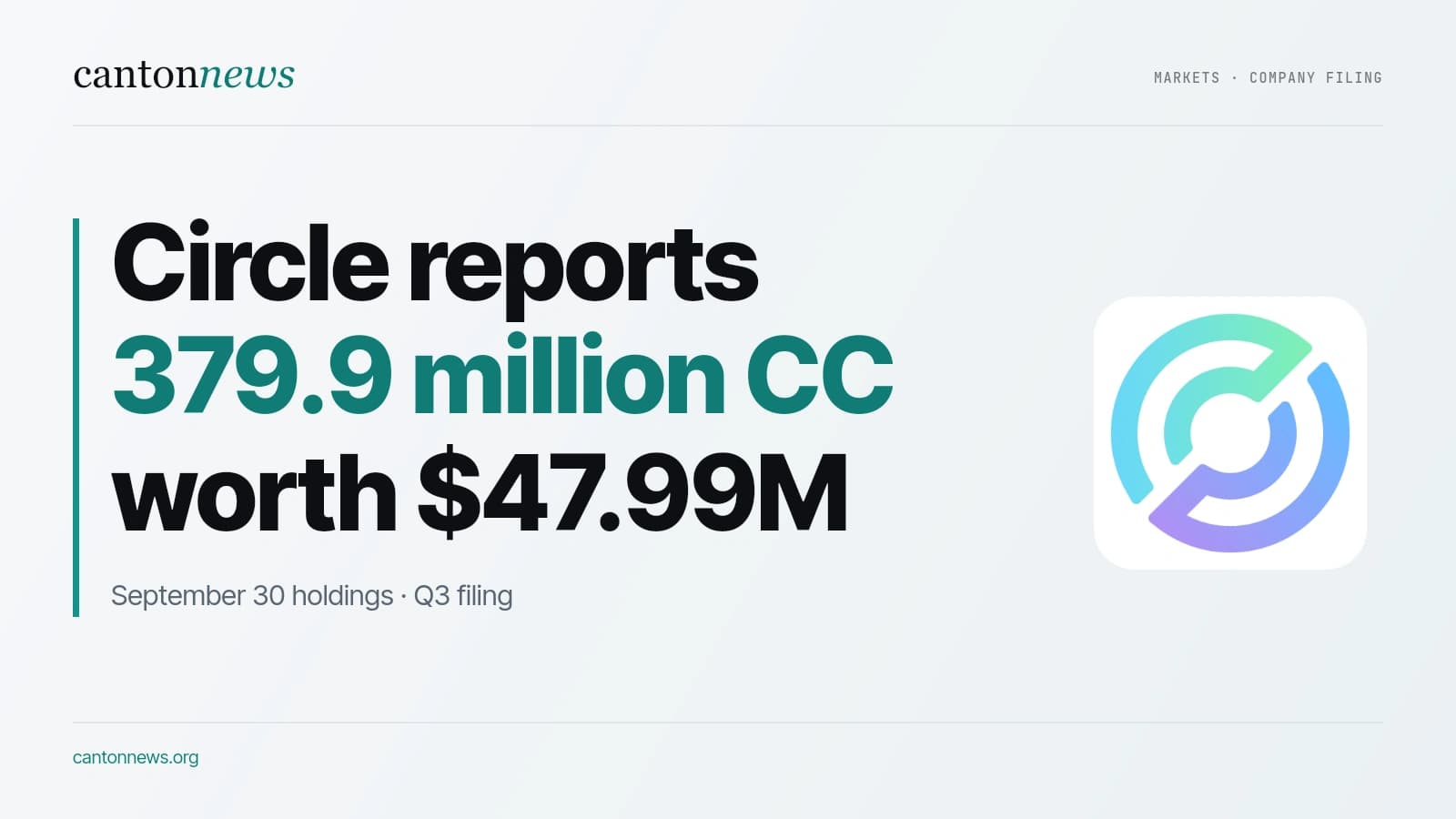

Circle’s September 30, 2026 holdings. Source.
Circle, the company behind USDC, held 379.9 million Canton Coin worth $47.99 million at the end of September, according to its third-quarter filing published on November 4. CC was the largest individually named holding by fair value in the filing’s digital-assets table.
The disclosure provides a dated look at Circle’s CC position. It also shows why a headline dollar figure needs context: compared with June, Circle held slightly fewer coins and recorded a lower value for them.
The figures at a glance
- CC held: 379,921,930 on September 30, 2026.
- Fair value: $47.987 million at that reporting date.
- Cost basis: $19.956 million, the amount recorded as the basis for the holding.
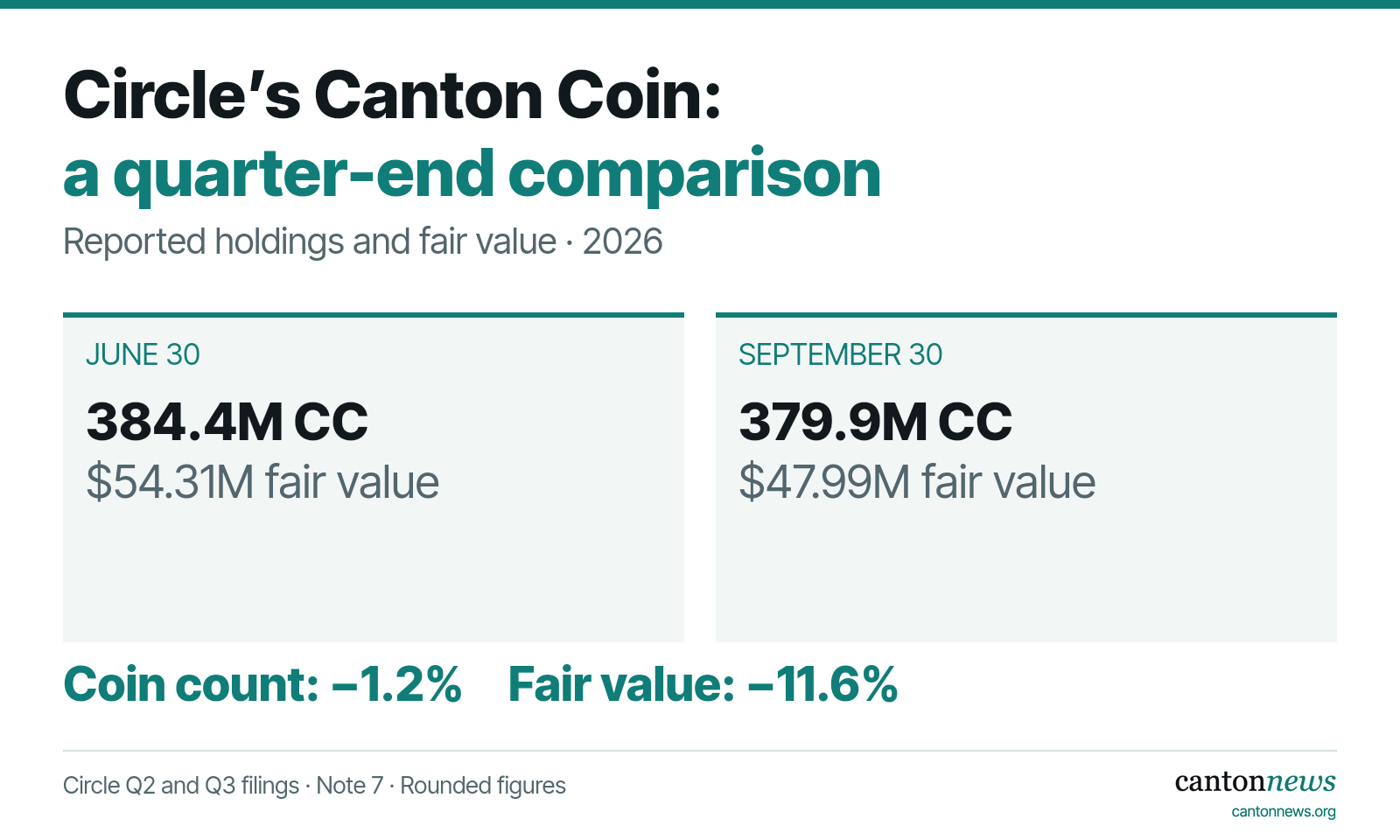
- Quarterly comparison: 4.52 million fewer CC than on June 30, a decline of about 1.2%.
Circle’s June 30 and September 30 balances. Q2 filing · Q3 filing.
What changed during the quarter
Circle’s June filing listed 384,446,370 CC with a fair value of $54.306 million. By September, the holding was smaller by 4,524,440 CC, while its recorded value had fallen by $6.319 million, or about 11.6%.
Those percentages describe different things. The coin count measures the size of the position. Fair value measures what that position was worth at each reporting date. A holding can lose value even when the number of coins changes only slightly.
Three terms worth separating
- Quantity: how many coins the company held.
- Fair value: the value assigned to the holding at the reporting date. It is not a cash balance.
- Cost basis: the recorded basis used to account for the holding. It is not the price someone would pay to buy the same quantity today.
The dollar columns in Circle’s table are stated in thousands; the quantity column is not. Its fair-value entry of 47,987 therefore means $47.987 million, while the coin count is the full 379,921,930 CC.
How this fits Circle’s Canton involvement
Circle has already outlined plans for native USDC in its Canton validator application. Its validator approval followed in October. Those are separate developments from the balance-sheet disclosure: the filing measures a holding at September 30, rather than confirming that a new product has launched.
The new filing should not be read as an announcement that Circle has just spent $48 million buying CC. Comparing the two quarter-end balances establishes how the reported position changed, but does not by itself explain the transactions behind that change.
Where to check the numbers
Both comparisons come from Note 7, “Digital assets,” in Circle’s quarterly reports. Reading the two tables together gives a more useful picture than treating the latest valuation as a purchase price.
Sources: September 30 digital-assets table · June 30 digital-assets table · Circle investor relations.